Showing posts with label Taos Society of Artists. Show all posts

Sunday, February 8, 2015

Taos Art Museum at Fechin House, a Historic Taos Home and Museum


In honor of the 100th anniversary of the formation of the Taos Society of Artists I am writing a few articles pertaining to the Taos Art Colony, here's one on the Fechin/Taos Art Museum: 

“Art is not an end to itself, but a means to addressing Humanity.”
M. Mussorgsky (Russian Composer) 1839-1881
 Fechin House through the Aspen Trees

Nicolai Fechin (1881-1955) in 1923 the family moved from Russia to New York City. He first visited Taos in 1926, the following year (1927) he moved to Taos with his wife Alexandra and daughter Eya.
Nicolai Fechin in the Taos Studio
Fechin purchased 7 acres of land and a small adobe home next to the estate of Mabel Dodge Luhan. There he began to build and carve out a home and studio to suit his own needs in 1928. Lumber was purchased at the nearby Randall Sawmill (the Randall Lumber & Hardware business still operates in Taos today) and ironwork was created with the assistance of the Bill Hinde Blacksmith shop (the same Blacksmith shop where the Broken Wagon Wheel was repaired). Fechin worked with a small crew of local craftspeople. On cloudy days or at the end of the day he would switch to carving the elements that make up this magnificent house. This masterwork of carpentry has been inspiring woodcarvers from near and far since it was begun. In 1979 the house was listed on the National Register of Historic Places. When Alexandra asked for a divorce Nicolai moved to NYC for a short time with Eya, later deeding the house to his former wife. He moved on to Palm Springs, Hollywood and then to Santa Monica, California becoming a much beloved artist and teacher to a new generation.
Cardboard Model of the house as Fechin worked on it.

“Fine painting is simply a matter of putting the right colors in the right places on canvas.” Nicolai Fechin 
Panorama of Fechin Portraits

Fechin is known mostly for his portrait drawings and paintings. He also created narrative and historical paintings. The texture of his paint, a flash of brilliant eye dazzling color, his balance, the manipulation of matte to gloss is what artists respond to. His canvas was primed sometimes with rabbit skin glue, then gessoed with a mixture of white casein ground (casein is a mixture of a milk substance, in this instance derived from cottage cheese, mixed with a pigment), this preparation could effectively absorb the mediums used in oil paints. He worked with brushes, palette knives and his fingers, at one point developing blood poisoning from the various paint pigments. A Fechin drawing has a textural quality extremely different from every other artist, thus highly recognizable as a “Fechin”.
Fechin Self Portrait

"We stand before a work of art and our spirit is lifted by it: amazing that someone is like us! We stand before a work of art and our spirit resists: amazing that someone is different!" Katherine Mathilda ‘Tilda’ Swinton (1960-)
Rebecca Salsbury James & John Young-Hunter dressed for the annual Taos Fiestas

While in Taos he seems to have kept to his work, even when he’d take a break and go fishing he went on his own. His friends here were Mr. & Mrs. John Young- Hunter, along with Bill & Rebecca Salsbury James.
Fechin and fellow Russian artist Leon Gaspard who came to Taos in 1918, and built his own home here, were not known to be friendly towards one another. Both men had rather feisty reputations among the many others in the small art colony. It’s rather odd that 2 Russian artists settled in Taos, New Mexico at this time period. From what I read about this coincidence there are similarities to their homeland in Taos with the landscape and indigenous people, I believe this to be a bit of a stretch. Artists are a competitive group, in a small art colony where each is trying to stand out, to this day it is a constant struggle. Imagine someone visiting Fechin’s studio, seeing a painting they might want to purchase, then telling him they would first visit Gaspard’s studio before deciding. Gaspard may then sell them a painting for a bit less and vice versa, it would be cutthroat (it still is).
Carved Swinging Doors to the Great Room of the Fechin House

“Art does not stand still.” Leon Gaspard (1882-1964)
Short video of the Taos Society of Artists room.

Today the Taos Art Museum at the Fechin House is a proud example of one of the very best Historic Home Museums here in Taos, NM. The collections include the paintings of Nicolai Fechin and examples of the Taos Society of Artists and other Taos Art Colony artists.
A few of my favorite paintings in the collection are Walter Ufer’s ‘Kit Carson House’, ‘Indian Man and White Horse’ by Bert Phillips and ‘Tulips’ by Andrew Dasburg, all beautiful examples of early Taos art.
 Walter Ufer "Kit Carson House"
 Bert Phillips "Indian Man & WHite Horse"
Andrew Dasburg "Tulips"
While viewing the collections please be sure to also take a look at the interior itself, furniture, beams, doorways and lintels are all hand carved with various motifs, a bit of Russian style meets Southwest style. The woodwork today is maintained with a bit of S.C. Johnson’s Paste Wax from time to time, keeping the luster of the wood rejuvenated in the dry Taos air.
Carved Post and Fireplace in the Great Room
The building is open to 2 floor levels, there is currently no wheel chair access to the second floor, the first floor I am told by staff is a bit tricky to navigate (stepped levels) for those using wheelchairs, they will do their best to accommodate.
Three Dorothy Brett Paintings upstairs
Exhibitions change from time to time, mostly they are held on the second level. It’s best to check the T.A.M. website to see exactly what is on display at any given time, www.taosartmuseum.org
Fechin Studio window with Northern Light
The Fechin Studio is a separate building the front room of which today houses the museum gift shop. Saturday afternoons throughout the year hands-on workshops and demonstrations are held in the large studio itself. Both of these rooms are not to be missed, staff is welcoming and want you to enjoy the entire experience of this treasured museum.
Carved Cabinet Door inside Fechin Studio

Recently I asked one of the staff members to tell me if she had any particular favorite work of art in the collection, her response; “Where do I begin, there are so many beautiful treasures here.”
Painting to the left by E. Martin Hennings on the right by Herbert Buck Dunton
A bit of background to the Museum:
The Taos Art Museum at Fechin House originally formed as the Van Vechten/Lineberry Taos Art Museum in 1994 to honor the wife of Edwin C. Lineberry and their collections. His wife Duane Van Vechten passed away in 1977, she was an artist who studied with Taos artist Emil Bisttram, yet she shied away from ever selling her artwork. They named their home “El Rancho de la Mariposa” which was decorated with a butterfly motif throughout. Edwin & Duane also built the Kachina Lodge which she helped design Zuni Knifewing and Kachina motifs to enhance its appearance.
Zuni Knifewing Architectural Drawing for Kachina Lodge by Duane Van Vechten, available exclusively at Two Graces Plaza Gallery
The Van Vechten/Lineberry Museum eventually closed and merged with the Fechin Institute in 2003. Much of the original collection was sold at auction. Recently the V/L buildings were opened to an Estate Sale where much of the remaining household items and collectibles were sold off.
Abstract Painting by Mrs. Duane Van Vechten at Taos Art Museum
The Van Vechten home (which is currently closed to the public) is located at 501 and the Fechin at 227 Paseo del Pueblo Norte, (approximately 3 blocks form each other).
The Fechin Institute (basically a historic home opened to the public) was founded by Eya Fechin in 1981, it had begun to fall into disrepair before her death in 2002. Eya’s son & daughter-in-law sold the house to the Taos Art Museum foundation.
                                                               Taos Blue Door and Gate at the Van Vechten Lineberry Home
The Worldmark Hotel, a Wyndham Resort is built in the style of the Fechin House, it’s located directly behind the Museum. www.worldmarktheclub.com/resorts/ta/ the telephone is 575-751-3275
If you were to drive straight back through the fence and wall at the back of the parking area you would be driving onto the Mable Dodge Luhan B&B property.
Fechin at his easel Painting

The Taos Art Museum at Fechin House is a true jewel in the necklace of museums and historic homes we are so very fortunate to have and enjoy here in Taos. Their telephone number is 575-758-2690

Monday, January 12, 2015

Taos Society of Artists July 15, 1915 100 year anniversary, Membership Who's Who (Part 2 of 6)


“For heaven’s sake tell people what we have found! Send some artists out here.” Bert Geer Phillips 1898
Blumenschein, Berninghaus, Couse, Phillips, Dunton (seated), Sharp

The first annual meeting of the Taos Society of Artists was held July 15, 1915 at the home of Dr. & Mrs. Thomas Paul ‘Doc’ Martin in the main dining room. Dues for members and associates were decided to be $5. Today their house is the Taos Inn, that very same dining room is the wonderful restaurant Doc Martin’s. The Adobe Bar by the lobby is known as ‘The Living Room of Taos’. 
E.I Couse the first President of the Taos Society of Artists
Ernest Blumenschein

The following year the group again met on July 15, (1916) at Berninghaus’ studio.
Oscar Berninghaus
Bert Phillips

The original 6 members include:
Joseph Henry Sharp (1859-1953) first visits Taos in 1893
Ernest Leonard Blumenschein (1874-1960) first visits Taos in 1898
Bert Geer Phillips (1868-1956) first visits Taos in 1898
Eanger Irving Couse (1866-1936) first visits Taos in 1902
Oscar Edmund Berninghaus (1874-1952) first visits Taos in 1899
William Herbert “Buck” Dunton (1878-1936) first visits Taos in 1912 
Joseph Sharp
Buck Dunton

Victor Higgins (1884-1949) to Taos in 1913 joins in 1917
Walter Ufer (1876-1936) to Taos in 1914 joins in 1917
Taos Pueblo Governor Manuel Lujan w Victor Higgins
Walter Ufer
Julius Rolshoven (1858-1930) joins in 1918
Ernest Martin Hennings (1886-1956) to Taos in 1917, joins in 1924
 Julius Rolshoven
E. Martin Hennings
The Taos Ten

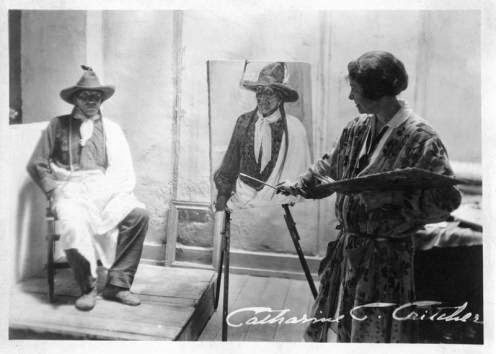
Catherine Carter Crichter (1868-1964) unanimously voted into the Society and the only female member joins in 1924
 Catherine Crichter
 Kenneth Miller Adams (1897-1966) joins in 1926
Kenneth Adams

Associate Members were made up mostly of artists living in Santa Fe, they include:
Robert Henri (1865-1929)
Albert L. Groll (1866-1952)
Randall Davey (1887-1964)
B.J.O. Nordfelt (1878-1955)
Gustave Baumann (1881-1971)
Birger Sandzen (1871-1954)
John Sloan (1871-1951)

The Honorary Members included:
Edgar L. Hewitt (director of the Museum of Fine Arts, Santa Fe/formerly the Museum of New Mexico Art Gallery)
Frank Springer (arts patron)
Taos Artists at the Don Fernando Hotel

Most of the artists at one time or another also belonged to or were associates of other arts guilds, colonies and organizations. Almost all had studied at one time or another in Europe.

“The very air of Taos country, its nearness to big works of nature drives caution from man’s brain. He takes a chance. Perhaps this has led the Taos painters to be original and to be so devoted to the country and it’s people.” Victor Higgins 1917
A few years later Higgins ran for Mayor of Taos, amazingly he lost by 12 votes!
 Victor Higgins at Taos Pueblo
The notion of these artists having romantic visions through their paintings of Native Americans has been expressed a great deal by other writers. I would like to add to this scenario that these men were indeed romantics, their entire way of life of moving to an idealized west to paint could be considered romantic or foolhardy, but too, these men were gentle and kind of spirit towards their partners who they adored. Much of the correspondence between these men and their wives is quite romantic, much of their actions toward their spouses is wonderfully romantic. Often their wives helped manage careers of these men who were dedicating as much of their time as possible to creating masterpieces.
That's Mrs. Dunton posing on horseback while Buck paints

The Taos Founders presented their vision to a fascinated public who wanted more and couldn’t get enough. These artists documented what they witnessed and what they were exposed to on a regular basis in Taos, whether Native American ceremonies or day-to-day life of the Hispanic people around them. Everything and anything was subject matter for these painters. Most of what was being painted still exists to this day in and around Taos. Buildings have changed, streets are paved and are named, the population has grown, the way people dress has changed, yet the mountains remain reflected in the magical shifting light under a sky of ‘Taos blue’, the cultural ceremonies of the people and the daily struggles of living in a remote mountain town remain.
Taos Plaza 1907

I have already mentioned in ‘part 1’ of this story line that most of the artists did not stay in Taos during the harsh winter months, eventually they do, but not early on, except for Phillips who settles in Taos upon his arrival.
Artist easel in Winter

The first motivation for the artists to band together may have been an exhibit at the Santa Fe Palace Museum in 1914. They also had a second exhibit there in 1915 and for a while annually. The museum may have slipped in a few Santa Fe artists along the way, motivating the Taos Society to give a few of these artists Associate status. Adding a few extra members also raised more funds with billing for annual dues. The exhibitions were wildly successful drawing large crowds who through the years seemed to have admiringly followed these homegrown artists and looked forward to their annual exhibits in Santa Fe.

It’s also important to note that in Europe, World War 1 was taking place during the years 1914-1918. How this affects true American Painting and these artists is up to debate. It would seem that the availability of European paintings would be scarce, and that there would be a rising market for American paintings.
Taos Plaza onlookers with Taos Pueblo ceremonial Dancers 1908

The original goal was to gather a group of paintings to be sent on a traveling schedule across the country through the support of galleries, museums, art and arts minded organizations. At the outset sales were brisk, yet towards the end the artists began adding contractual obligations to the exhibitors asking that they guarantee at least one sale by each artist. If the exhibitor could not sell to a client they would need to purchase paintings outright for their own inventory.

The group exhibitions they sent on tour included each artist’ very best work, absolute masterpieces. Each and every one of these paintings would impress even the most casual visitor to any gallery. The paintings themselves were often quite large. When you consider the crating and shipping paintings to each venue, this was quite an undertaking.
Ufer standing under the furniture sign, he has a tall hat on his head and is in profile looking left 1933

As for exhibiting their work in Taos during this time period there were not as yet any galleries to exhibit in. There were no art galleries in Taos prior to 1933. Thus the artists would welcome visitors to their studios and homes where paintings were on display to collectors looking to make purchases. Ufer may have been the one exception, on his studio door at one point he posted “Keep Out TNT Explosive” in hopes of frightening off curiosity seekers. Yet Ufer was known to talk to visitors into the night, lest he not get any painting done, I believe he needed to focus, and this was the best way he could imagine to divert distractions. The Taos artists seemed to have had a unique understanding of what buyers would be able to take with them upon purchasing. Each of them made what they referred to among themselves as ‘suitcase paintings’, sizes that could fit into the average luggage of travelers of this time period.
Taos Pueblo represented in the Panama-(San Diego) California Exposition brochure 1915-1917
In the early 1920’s the Fred Harvey tours begin arriving in Taos with visitors requesting two things, a trip to the San Geronimo de Taos Pueblo and a visit to an artist studio.


Phillips, Sharp and Couse collected blankets, beaded bags, pottery, beaded moccasins, basketry, kachina dolls, and various Native American artifacts to use as props. More than likely they also loaned and traded each other for desired objects to complete authentic looking scenarios.
Taos has been a trade route for more than a few100 years, with the Mountain Men visiting and the roaming Native peoples who followed the great migratory routes of wildlife. Much cultural material has been brought into Taos for quite some time, in particular traded to the people of Taos Pueblo. It’s not surprising to visit someone’s home there and see a Northwest Coast artifact or a pair of beaded Ute moccasins.

In 1915 Mrs. Ellis and Mrs. Lina Scheurich (Governor Bent's Granddaughter) opened the first art supply store making available to the local artists the very best art materials being provided by the Royal Society of Art.
Taos Pueblo today with Taos Blue Sky above

It’s all about marketing, the Taos Founders formed to enable these artists a way to market their paintings. Comparably this could be thought of as a Taos Founders “Wild West Travelling Show” featuring paintings on canvas rather than real live rodeo Cowboys and Indians on horseback. By exhibiting paintings of a so-called ‘vanishing’ American West in viably strong economic markets, winning various nationwide competitions adding cache to and making their works more desirable, making Taos, New Mexico in the Southwest a destination for visitors from all over the Country. None of this would have been possible without a whole lot of dedicated hard work and truly great talent.

Henry Balinck, Nicolai Fechin, Joseph Fleck, and Leon Gaspard had all been blackballed. A number of reasons were given, yet the most likely would have been the fact that they were selling paintings quite profusely. In an 18 week time period Balinck had sold 16 paintings while in Taos!

A great deal of research reading everything I could get my hands on from scrapbooks to gallery catalogues to monographs and everything in between has gone into these stories. I find that nothing has really changed in Taos, or in any small town art colony. We struggle, we quibble and bicker, we become territorial, along with horrific jealousies, all of which are better left unsaid. At the end of the day making art and finding the market for that art are after all, struggles enough.
 “Ourselves and Taos Neighbors” Ernest Blumenschein (collection of the Stark Museum)

Seated left to right: Bert Phillips, Mrs. Lucille Harwood, daughter Helen Blumenschein Standing left to right: Oscar Berninghaus, Woman?, Dr. Light, Walter Ufer, Leon Gaspard, Mrs. Lucille Couse, D.H. Lawrence, Mrs. Lockwood, Mrs. Mary Blumenschein, Joseph Sharp,  Kenneth Adams, Mabel Dodge Luhan, Mary Austin. Tony Lujan, Ernest Blumenschein, D. Martinez Mote, Taos Pueblo woman and 2 Taos Pueblo men

2015 marks the 100th anniversary of the formation of the Taos Society of Artists on July 15, 1915. Thank you for your interest, I hope that you will visit us in Taos and wonder at what was past and show your support to the artists of this art colony 75 miles north of Santa Fe.