Showing posts with label Taos Art. Show all posts

Saturday, December 16, 2023

Gene Kloss (1903-1996) A Printmaker in Taos

Gene Kloss (1903-1996) Alice Geneva Glasier

Gene Kloss 
“Enduring Sanctuary” 12” x 15”, frame size 21” x 23” (etching, Drypoint & aquatint) 1973, 
50 of the edition of 50

Thousands of artists have drawn or painted the Ranchos Church, the huge adobe buttresses a unique composition. PK

In 1925 the newly wed Gene & Phillips Kloss honeymooned in New Mexico. “The first site of the vast Taos Plateau left us breathless.” Phillips. In Taos Canyon, Gene “did innumerable paintings and drawings” and produced etchings on a small portable press (a sixty-pound machine) which she had Phillips set up on a tree stump near their campsite. The rare examples of Watercolors, Pen & Ink, Drawings and even Oil Paintings show how immensely talented she was, but Etching (and the variations of etching she developed) was her preferred almost obsessive way of creating art. From my own personal experience at SMFA I understand just how obsessed printmakers can become.

It is through her etchings that Kloss shines as a master of light & darkness, setting the stage onto her rectangular shaped paper surface. Looking at the etchings of Rembrandt, you’ll clearly see just how much of a master of the art form of etching she became. Kloss prints glow and shine through the darkness, the drawing and tonal quality of her hatch marks are precise and complicated. Her forced perspective will draw you into the scene allowing you to be a part of it as if you were witness to a moment in time.  


Gene Kloss' work was exhibited in Paris at the Musee Jeu de Paume in 1938, as part of a leading New Mexican artist exhibition alongside Ernest Blumenschein, Georgia O'Keeffe and John Sloan.


The Klosses attended ceremonial dances at Taos Pueblo so regularly that once when they missed one, their Pueblo friends sent someone to the Kloss home to make sure they were alright. Kloss never owned a camera, but constantly sketched and relied on an impeccable visual memory. “Gene makes memory sketches of indian activities from her own point of view, with respect for the unknowing Indian point of view.” Phillips Kloss


“Her very best work gives us a chance to be in that moment with her. She purposely priced her work, under market value. She wanted to make it accessible to as many people as possible. Gene depicted the life of the people as she saw it at the time (1930’s). In some ways she was capturing something that had been around for centuries. What she saw and what she recorded in her own memories, she passed down to us. Taos has always been, and still is, a place where women who happen to be artists got more attention than other artists (colonies). Taos was a place where artistic talent really was appreciated.” David Witt, for Colores, PBS 10, 23, 2021


Many women artists find a great lack of interest and respect towards their respect work, Kloss used "Gene" (a masculine form of Geneva) when signing her artworks, to avoid prejudices of gender. Since 2019 much like Hilma af Klint, museums, curators and the public alike are searching for that extraordinary ‘undiscovered’ female artist, Kloss has been ‘hiding’ in plain sight here in Taos for almost 100 years.


“What Gene Kloss can catch in metal and oils, Phillips Kloss grasps and paints in words.” Hal Johnson, for Berkley Daily Gazette 11, 14, 1942


‘The Woman in the Woods’ Phillips Kloss

’tis not the grove green hills you love nor blue-green sea,

’tis not the lonely luring trail, ’tis She

and puts the verse in water, rock, and tree.


’tis not the search for the truth that makes your life seem real

nor sense of power. ’tis love’s ideal

that gives the purpose to your thought, the zeal

which even single souls vicarious feel.

Gene Kloss 
“Forsaken Church (on the Edge of the Great Plains) 9 7/8” x 17 7/8” (etching, drypoint) 1979, 
9 of the edition of 25
.…untouched by vandals, it simply had to be sketched. We didn’t inquire its history. It is a sermon to space. PK

Gene Kloss
“Approach of the Victors” 11 3/8” x 7 7/8”, frame size 14.5” x 17.5” (drypoint) 1947, 
Proof from the edition of 10

Gene Kloss 
“Dance of Domingo” 10 5/8” x 13 5/8”, frame size 18” x 22” (drypoint & aquatint) 1955, 
Proof of the edition of 40

Gene Kloss 
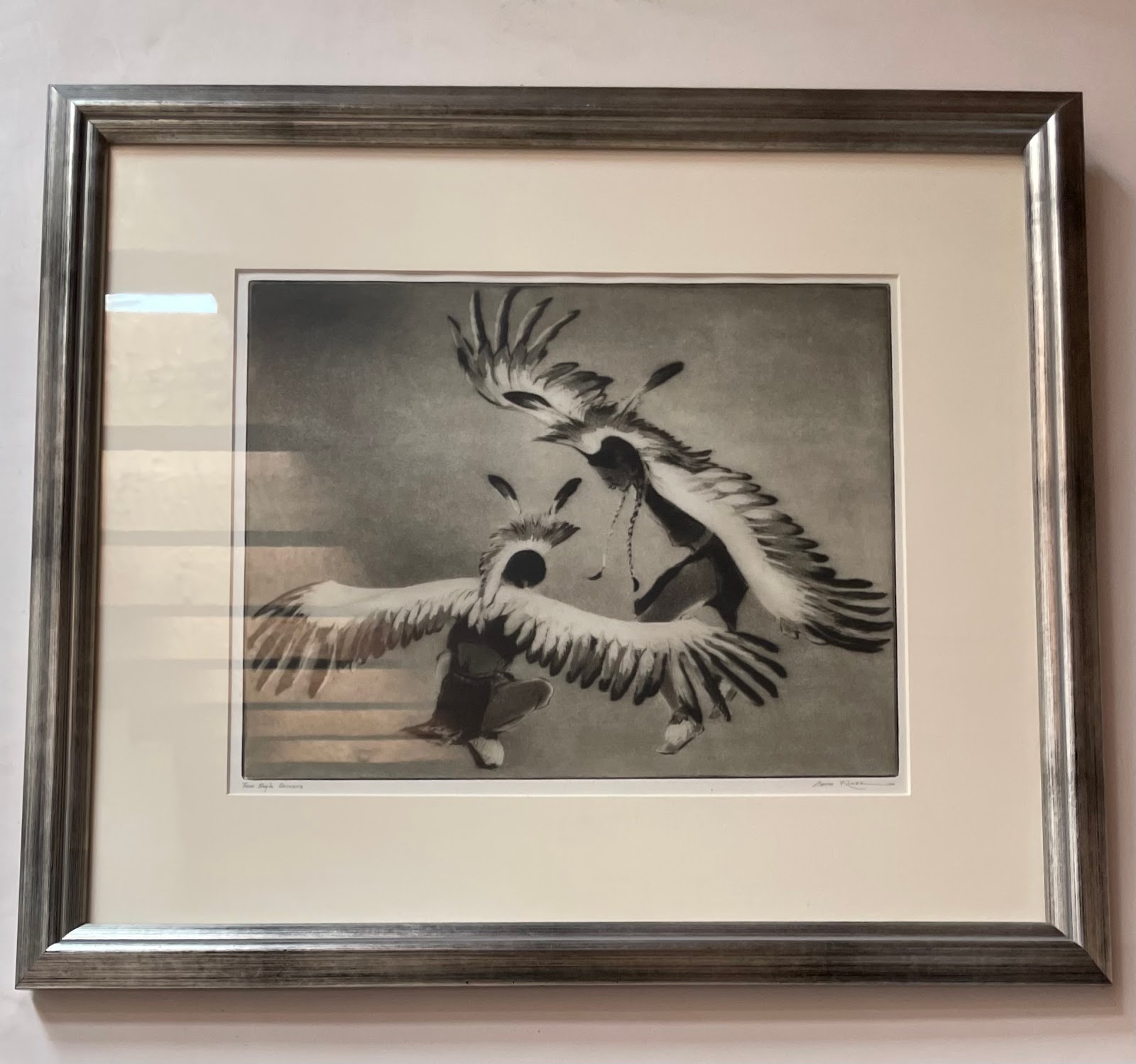
“Taos Eagle Dancers” 10.75” x 13.75”, frame size 20” x 23” (drypoint & aquatint) 1955, 
Proof of the edition of 35
The Eagle dance simulates the movements of the great bird beating its wings to rise from the ground, lifting in the air, soaring in the sky.” PK

Gene Kloss 
"Years Ago in Arroyo Seco"
5 5/8" x 8 1/8" (drypoint etching) 1981
Artist Proof (stated) Edition of 50
Available at R.B. Ravens, Ranchos de Taos

Gene Kloss
"Christmas Processional at Taos II"
9 7/8" x 13 7/8" (drypoint impression) 1948
From the edition of 50 
This was printed by Kloss after the 250 edition printed for the Society of Print Connoisseurs which is titled "Processional - Taos"
Available at R.B. Ravens, Ranchos de Taos

Gene Kloss 
“Watching the Clowns” 11 7/8” x 8 7/8”, frame size 17” x 21” (original watercolor) 1954


Gene Kloss 
“Rio Grande Canyon (slide trail)” 13.75” x 9.75”, frame size 27” x 20” (original Pen & Ink Drawing) 1936
The basaltic Taos river gorge drops into the basaltic Rio Grande Gorge, a ledge road hanging over a precipice once the main road between Santa Fe and Taos. You went up in low gear and down in low gear. You hugged the inside rut when the road was icy hoping your car wouldn’t decide to make a ski slide out of it. PK


Gene Kloss
“Singers Over the Bridge” 10 7/8” x 13 7/8”, frame size 22” x 19.5” (etching, drypoint) 1961, 
48 of the edition of 50
$3,600.
Available through Wilder Nightingale Fine Art, Taos

Gene Kloss
“Zero Weather” 8 3/4” x 14 3/4”, frame size 23.5” x 19.5” (drypoint, aquatint) 1960, 36 of the edition of 50
$3,600.
Available through Wilder Nightingale Fine Art, Taos

‘Winter Sonnet’ Phillips Kloss (1902-1995)

When Taos was Taos years yond ago,

valley and mountains sky-enchanted,

streams aflow with melting snow,

fields sheen green new-ploughed new-planted,

there you could live in an ageless age,

live in the cedars, live in the sage,

cedar and sage, wild rose, wild plum,

Indian song and Indian drum.


’tis not to deny the mind’s delight -

imagine, explore, invent, create -

’tis living more natural, primitive, right

fulfilling the faith that you advocate.

Don’t seek tomorrow, go back there

in the pine, in the spruce, in the balsam air,

in the cedars and sage, wild rose, wild plum,

fear nothing that will come.


(Poetry works from “Taos Chants” by Phillips Kloss 1974)


Gene Kloss
“Magpies & Red Tailed Hawk” 14 7/*” x 8 7/8”, frame size 17” x 21” (etching, drypoint) 1962, Proof from the edition of 50
$3,600.
Available through Wilder Nightingale Fine Art, Taos

They ganged up on him, yak yak sacked at him for trespassing on their territory. He regarded them with imperturbable disdain. Handsome birds, black and white and iridescent green, they made lively patterns in the stark trees. PK

Gene Kloss 
Taos Devil Dancers 20” x 22” Giclee
$100. (unframed) SOLD
Partly an entertainment dance, partly an exorcise dance, the Devil Dance is put on by a group going from house to house. PK

Gene Kloss

“Morning Worship” 22” x 18.5” Giclee

$100. (framed) SOLD


Gene Kloss An American Printmaker, A Raisonne
2 Volume set
written by Gene Sanchez
SOLD OUT

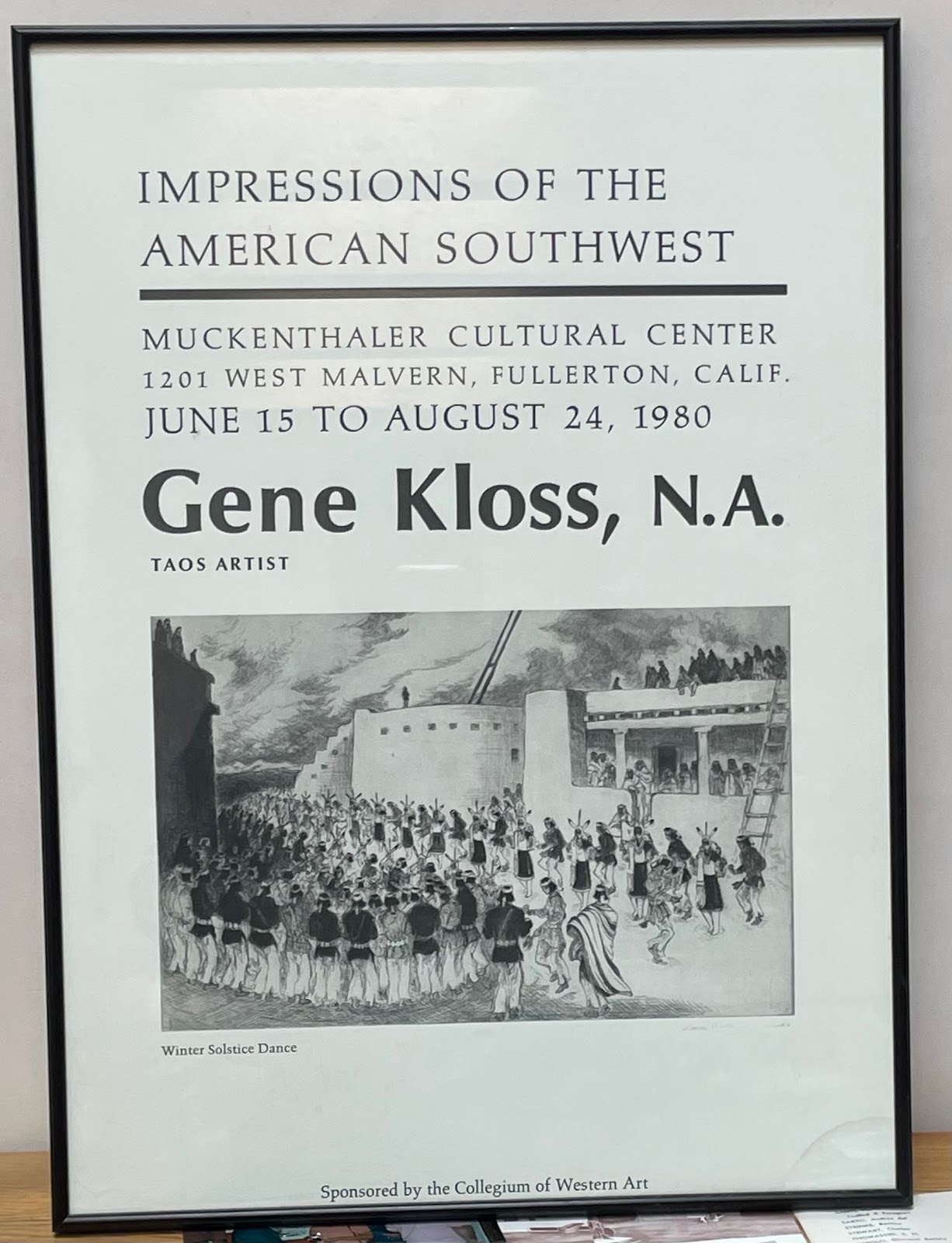
Gene Kloss Poster

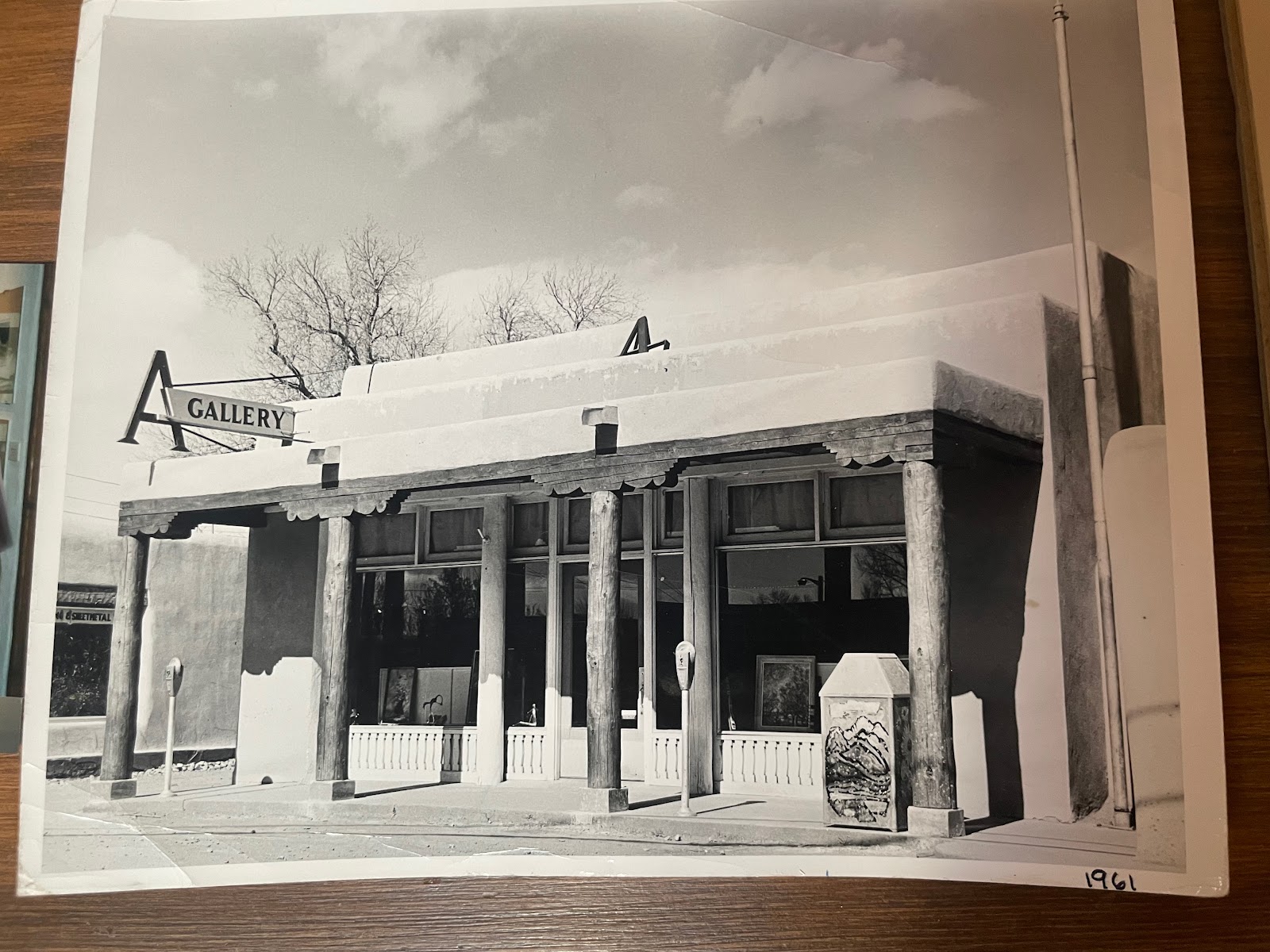
Photograph by Dick Spas of the Gallery A storefront on Kit Carson Road

“It was about 1937… when I first saw her etchings, I remember I stopped by La Fonda Hotel (Taos) and her etchings were spread out in a back room. There was one - ‘Snow and Adobe’  (1934) - I had to have it. I had 68 cents with me and Dixie Yapple, who ran the gallery (Taos Heptagon Gallery), said ‘Why don’t you go ahead and get it. You can pay a little at a time.’ You know that was my grocery money, but I bought that etching for $5.” Mary Sanchez, from Pasatiempo, Santa Fe New Mexican 7, 7-13, 2000 


“Kloss was amazingly humble and talented. She set out to capture the images and history of New Mexico and accomplished it like few others. The quality and integrity of her work is hard to compete with.” Jules Sanchez, from Taos Magazine, May-June 2005


Gallery A scenes at 1996 opening for Gene Kloss Works of Art

Gallery A was the exclusive dealer for the artworks of Gene Kloss for over 50 years. The artworks shown here by Gene Kloss are the last of the Sanchez family collection the former owners of Gallery A. 
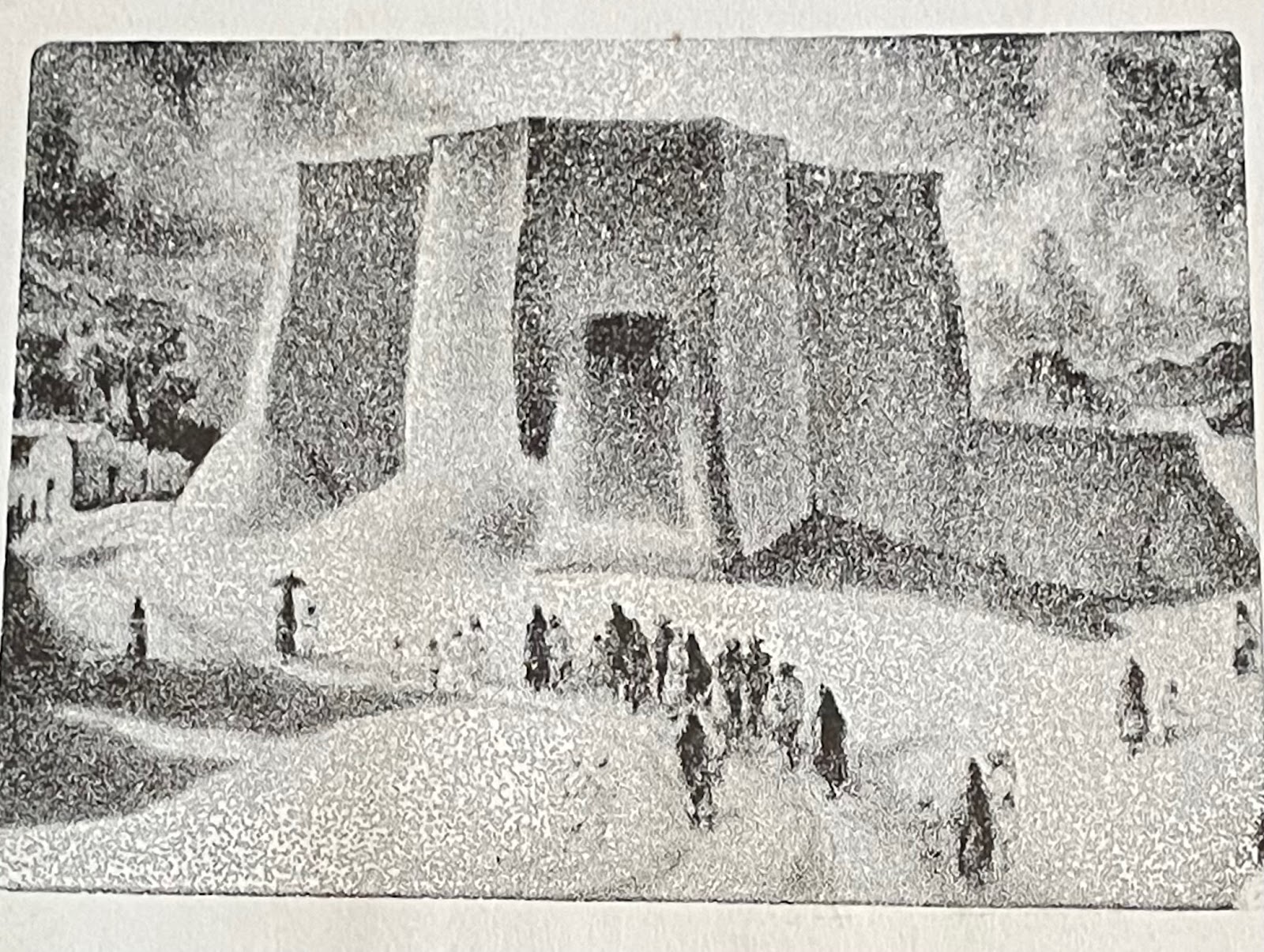

Christmas Card of Enduring Sanctuary in Snow
Mezzotint printed by Bill Jackson


Sunday, June 6, 2021

Ila McAfee Miniature Portrait Taos Pueblo Man

 Ila McAfee (Turner) 1897-1995

Studied in Los Angeles, CA, Chicago, IL, New York, NY, moved to Taos, NM in 1928. She remained in Taos for twenty-five years before moving back to Colorado. She is noted for her paintings of animals, horses in particular.


A 3”x3” in a 4 5/8”x5 1/8” frame, an oil painting portrait on canvas of a Taos Pueblo gentleman. Sgrafitto signature on the front and her written signature on the back brown paper.


Note the earring and braids tied in red (denoting a particular society group that this man belonged to), with Taos Pueblo and blue mountain in background. Dated to 1930, signed on front and notation on back. The man wears a robe (an indication of stature) of green, the color of life, renewal, nature and energy, associated with growth, harmony, safety and the environment and around him. 


Portraits and the portrait miniatures of the people in Taos are some of Ila’s best work, yet still she was known as the painter of horses. Most portraits are on simple backgrounds. This rare Portrait of a Taos Pueblo Man by Ila McAfee includes views of the Taos Blue Mountain and the Taos Pueblo in the background. 


From Ila's book "Indians, Horses, Hills, et cetera..." : 'Sun Lightning' was his indian name. I would meet him out in the sage and sun and there, wrapped in a bright colorful blanket, he sat on his horse. I painted him with a mountain or prairie as a background in the center of a beautiful setting. People from Taos Pueblo have identified him as Joe ‘Sunhawk’ Sandoval, along with pointing out the hoop earring and red colored ribbon wrapping his braids. The book includes this illustration of the man she refers to.


In a sketch by Ernest Blumenschein a similar looking Pueblo Man is depicted.


Ila met her husband to be Elmer Page Turner (yes, read it again ‘Elmer page turner’) through art classes at the Chicago Art Institute in 1920, whom she married in 1926. Ila and Elmer designed and helped build their home on what was then known as Armory Street, now Civic Plaza Drive, which was finished by the end of 1928. Named the “White Horse Studio” it is an assuming two story house nestled into now a busy street. It is thought that Ila carved the animal figures into the lintels over the exterior door and windows. A viewing of the videos Ila McAfee’s Trained Cats in particular Sanka the Siamese, will give you an inside look into their home.


Little known and seemingly forgotten about McAfee is that she designed fabrics, wrapping paper, dishes, calendars and illustrated the cover of “How to Draw Horses” by Walter Foster


Ila McAfee is included in the book “Taos and its Artists” Mabel Dodge Luhan 1947. As one of the earliest painters in Taos, she is considered today one of the very best. Voted Taos Artist of the Year in 1981.


This Painting has been SOLD


Sunday, February 8, 2015

Taos Art Museum at Fechin House, a Historic Taos Home and Museum


In honor of the 100th anniversary of the formation of the Taos Society of Artists I am writing a few articles pertaining to the Taos Art Colony, here's one on the Fechin/Taos Art Museum: 

“Art is not an end to itself, but a means to addressing Humanity.”
M. Mussorgsky (Russian Composer) 1839-1881
 Fechin House through the Aspen Trees

Nicolai Fechin (1881-1955) in 1923 the family moved from Russia to New York City. He first visited Taos in 1926, the following year (1927) he moved to Taos with his wife Alexandra and daughter Eya.
Nicolai Fechin in the Taos Studio
Fechin purchased 7 acres of land and a small adobe home next to the estate of Mabel Dodge Luhan. There he began to build and carve out a home and studio to suit his own needs in 1928. Lumber was purchased at the nearby Randall Sawmill (the Randall Lumber & Hardware business still operates in Taos today) and ironwork was created with the assistance of the Bill Hinde Blacksmith shop (the same Blacksmith shop where the Broken Wagon Wheel was repaired). Fechin worked with a small crew of local craftspeople. On cloudy days or at the end of the day he would switch to carving the elements that make up this magnificent house. This masterwork of carpentry has been inspiring woodcarvers from near and far since it was begun. In 1979 the house was listed on the National Register of Historic Places. When Alexandra asked for a divorce Nicolai moved to NYC for a short time with Eya, later deeding the house to his former wife. He moved on to Palm Springs, Hollywood and then to Santa Monica, California becoming a much beloved artist and teacher to a new generation.
Cardboard Model of the house as Fechin worked on it.

“Fine painting is simply a matter of putting the right colors in the right places on canvas.” Nicolai Fechin 
Panorama of Fechin Portraits

Fechin is known mostly for his portrait drawings and paintings. He also created narrative and historical paintings. The texture of his paint, a flash of brilliant eye dazzling color, his balance, the manipulation of matte to gloss is what artists respond to. His canvas was primed sometimes with rabbit skin glue, then gessoed with a mixture of white casein ground (casein is a mixture of a milk substance, in this instance derived from cottage cheese, mixed with a pigment), this preparation could effectively absorb the mediums used in oil paints. He worked with brushes, palette knives and his fingers, at one point developing blood poisoning from the various paint pigments. A Fechin drawing has a textural quality extremely different from every other artist, thus highly recognizable as a “Fechin”.
Fechin Self Portrait

"We stand before a work of art and our spirit is lifted by it: amazing that someone is like us! We stand before a work of art and our spirit resists: amazing that someone is different!" Katherine Mathilda ‘Tilda’ Swinton (1960-)
Rebecca Salsbury James & John Young-Hunter dressed for the annual Taos Fiestas

While in Taos he seems to have kept to his work, even when he’d take a break and go fishing he went on his own. His friends here were Mr. & Mrs. John Young- Hunter, along with Bill & Rebecca Salsbury James.
Fechin and fellow Russian artist Leon Gaspard who came to Taos in 1918, and built his own home here, were not known to be friendly towards one another. Both men had rather feisty reputations among the many others in the small art colony. It’s rather odd that 2 Russian artists settled in Taos, New Mexico at this time period. From what I read about this coincidence there are similarities to their homeland in Taos with the landscape and indigenous people, I believe this to be a bit of a stretch. Artists are a competitive group, in a small art colony where each is trying to stand out, to this day it is a constant struggle. Imagine someone visiting Fechin’s studio, seeing a painting they might want to purchase, then telling him they would first visit Gaspard’s studio before deciding. Gaspard may then sell them a painting for a bit less and vice versa, it would be cutthroat (it still is).
Carved Swinging Doors to the Great Room of the Fechin House

“Art does not stand still.” Leon Gaspard (1882-1964)
Short video of the Taos Society of Artists room.

Today the Taos Art Museum at the Fechin House is a proud example of one of the very best Historic Home Museums here in Taos, NM. The collections include the paintings of Nicolai Fechin and examples of the Taos Society of Artists and other Taos Art Colony artists.
A few of my favorite paintings in the collection are Walter Ufer’s ‘Kit Carson House’, ‘Indian Man and White Horse’ by Bert Phillips and ‘Tulips’ by Andrew Dasburg, all beautiful examples of early Taos art.
 Walter Ufer "Kit Carson House"
 Bert Phillips "Indian Man & WHite Horse"
Andrew Dasburg "Tulips"
While viewing the collections please be sure to also take a look at the interior itself, furniture, beams, doorways and lintels are all hand carved with various motifs, a bit of Russian style meets Southwest style. The woodwork today is maintained with a bit of S.C. Johnson’s Paste Wax from time to time, keeping the luster of the wood rejuvenated in the dry Taos air.
Carved Post and Fireplace in the Great Room
The building is open to 2 floor levels, there is currently no wheel chair access to the second floor, the first floor I am told by staff is a bit tricky to navigate (stepped levels) for those using wheelchairs, they will do their best to accommodate.
Three Dorothy Brett Paintings upstairs
Exhibitions change from time to time, mostly they are held on the second level. It’s best to check the T.A.M. website to see exactly what is on display at any given time, www.taosartmuseum.org
Fechin Studio window with Northern Light
The Fechin Studio is a separate building the front room of which today houses the museum gift shop. Saturday afternoons throughout the year hands-on workshops and demonstrations are held in the large studio itself. Both of these rooms are not to be missed, staff is welcoming and want you to enjoy the entire experience of this treasured museum.
Carved Cabinet Door inside Fechin Studio

Recently I asked one of the staff members to tell me if she had any particular favorite work of art in the collection, her response; “Where do I begin, there are so many beautiful treasures here.”
Painting to the left by E. Martin Hennings on the right by Herbert Buck Dunton
A bit of background to the Museum:
The Taos Art Museum at Fechin House originally formed as the Van Vechten/Lineberry Taos Art Museum in 1994 to honor the wife of Edwin C. Lineberry and their collections. His wife Duane Van Vechten passed away in 1977, she was an artist who studied with Taos artist Emil Bisttram, yet she shied away from ever selling her artwork. They named their home “El Rancho de la Mariposa” which was decorated with a butterfly motif throughout. Edwin & Duane also built the Kachina Lodge which she helped design Zuni Knifewing and Kachina motifs to enhance its appearance.
Zuni Knifewing Architectural Drawing for Kachina Lodge by Duane Van Vechten, available exclusively at Two Graces Plaza Gallery
The Van Vechten/Lineberry Museum eventually closed and merged with the Fechin Institute in 2003. Much of the original collection was sold at auction. Recently the V/L buildings were opened to an Estate Sale where much of the remaining household items and collectibles were sold off.
Abstract Painting by Mrs. Duane Van Vechten at Taos Art Museum
The Van Vechten home (which is currently closed to the public) is located at 501 and the Fechin at 227 Paseo del Pueblo Norte, (approximately 3 blocks form each other).
The Fechin Institute (basically a historic home opened to the public) was founded by Eya Fechin in 1981, it had begun to fall into disrepair before her death in 2002. Eya’s son & daughter-in-law sold the house to the Taos Art Museum foundation.
                                                               Taos Blue Door and Gate at the Van Vechten Lineberry Home
The Worldmark Hotel, a Wyndham Resort is built in the style of the Fechin House, it’s located directly behind the Museum. www.worldmarktheclub.com/resorts/ta/ the telephone is 575-751-3275
If you were to drive straight back through the fence and wall at the back of the parking area you would be driving onto the Mable Dodge Luhan B&B property.
Fechin at his easel Painting

The Taos Art Museum at Fechin House is a true jewel in the necklace of museums and historic homes we are so very fortunate to have and enjoy here in Taos. Their telephone number is 575-758-2690