Showing posts with label Tihu. Show all posts

Thursday, March 6, 2025

Route 66 ‘Trading Post’ Kachina Dolls

 The Development, History and Collecting of Route 66 ‘Trading Post’ Kachina Dolls

On Collecting Kachina Dolls, Part 4 (of a seven part series)

Robert Cafazzo 

Two Graces, Taos

A selection of Route 66 Kachina Dolls currently available at Two Graces, Taos

The development of Route 66 Kachina Dolls began as a way to market Kachina Dolls to visitors of the Southwest. Rather than carve legs and feet, the makers created a small ‘cone-like’ shape at the bottom of their carvings, allowing the carving to stand quite solidly. Variations of this cone shape include a notch cut at the front, rather than a completely rounded cone, as well as a cut through the bottom of the cone all the way up to the skirt/kilt (which in some way creates primitive style legs).

Longbeard, Hopi Maiden, Cloud Kachina 4" & 4.25" heights ca. 1920-30 $95.each (Maiden, at center, has been acquired)

Snow Kachina currently available at Two Graces, Taos at 3"tall at left $60. center 5"tall $225.(one available) at right 3"tall $50.

All are Currently Available

3" tall Abbot Longbeard $75. and a Pooley Longbeard $50.

Currently Available

3" tall Mini Rte. 66 Kachina Dolls

Bluebird (AS) SOLD Warrior SOLD. Crow Mother (AS) $75. Mudhead (AS) $75. Maiden (AS) SOLD. Eagle $50.

3 1/2" tall Mini Rte 66 Kachina Dolls
Hummingbird (AS) SOLD Owl $50. Flower SOLD. Rabbit/Runner (AS) $75. Konin SOLD

3 1/4" tall Mini Rte 66 Kachina Dolls
Tri-Colored Corn $50. Hakto (AS) SOLD Hummingbird $50. Blue Cloud $75. Lightning Cloud $50. Sun God $50.
All are Currently Available

As I’ve stated before, I’m not a fan of mounting Kachina Dolls onto bases, preferring to hang them on a wall or from the ceiling beams as the Hopi do in their own homes. The cone shaped base was a clever way to integrate a base format into the design of the doll carving itself. Kachina Dolls are not ‘weebles’, you do not want them to ‘wobble’ or fall down. A well made Kachina Doll carving should be able to stand on its own.

4 1/4" tall Pooley Rte 66 Kachina Dolls 

Rock Eater $125. Warrior $75. Rain Maker SOLD Rain Maker $75.

5 1/4" tall Rte 66 Kachina Dolls 
Longbeard (AS) $95. Bird (AS) $125. 6" Tall Hummingbird (AS) $175. Horse (AS) $125. Warrior Leroy Pooley Bear Paw stamp  $125. All are Currently Available

Another aspect to the style and format of these carvings is the position of their arms and hands over their stomachs which is where the coined term(s) Belly-Ache, Stomachache or Belly-Hugger dolls comes from. However, this style format exists in not only Rte. 66 doll carvings but in early Hopi Kachina Dolls as well.

A variety of Kachina Doll Carvings with the arms in the belly ache position


Carvings of this nature were primarily sold at the Fred Harvey Hotel shops and Trading Post shops of the Southwest, not only along Route 66 but throughout the Southwest.

The earliest Kachina dolls in the Route 66 style can be definitively traced back to the 1920’s where a simple black label stating “FROM THE HOPI VILLAGES” attached to the bottom or back of a doll indicates that this particular carving was sold at the Fred Harvey Grand Canyon Trading Post during this time frame. At some point in the late 1930's the label was changed to a red border.

From the Hopi Villages Fred Harvey Trading Post Label

A Doll currently available at Two Graces, Taos with the Harvey Label attached to the back 4" tall $295.


Rte 66 dolls range on average in size from 1 1/4” tall to 6 1/4” in height, with 2 3/4” & 4” being the standard sizes. They are primarily painted with a white clay base and a limited color palette using powdered tempera paints. These carvings have a symmetry that in some cases are thought to have been made by turning the cottonwood on a lathe. Many of them aren’t a completely rounded form and too, there aren’t ever indications of a lathe pin mark at the bottom of the carving (at the top there is always a hole for a feather). A piece of cottonwood turned on a lathe using a sharp chisel would in most cases shatter to bits. Abbot ‘Sun’ Sakiestewa one of the best of the Rte. 66 makers stated in his brochure, “Dolls which are obviously turned on a lathe are not Hopi made.” By the way, the replicas turned on a lathe with a hardwood are stamped ‘Made in Mexico’ on the bottom of the base. Without true clarification and explanation Abbot’s statement has been often repeated and misinterpreted. 

A Doll currently available at Two Graces, Taos with the Abbot Sun Rubber Stamp on the bottom and a split cone 

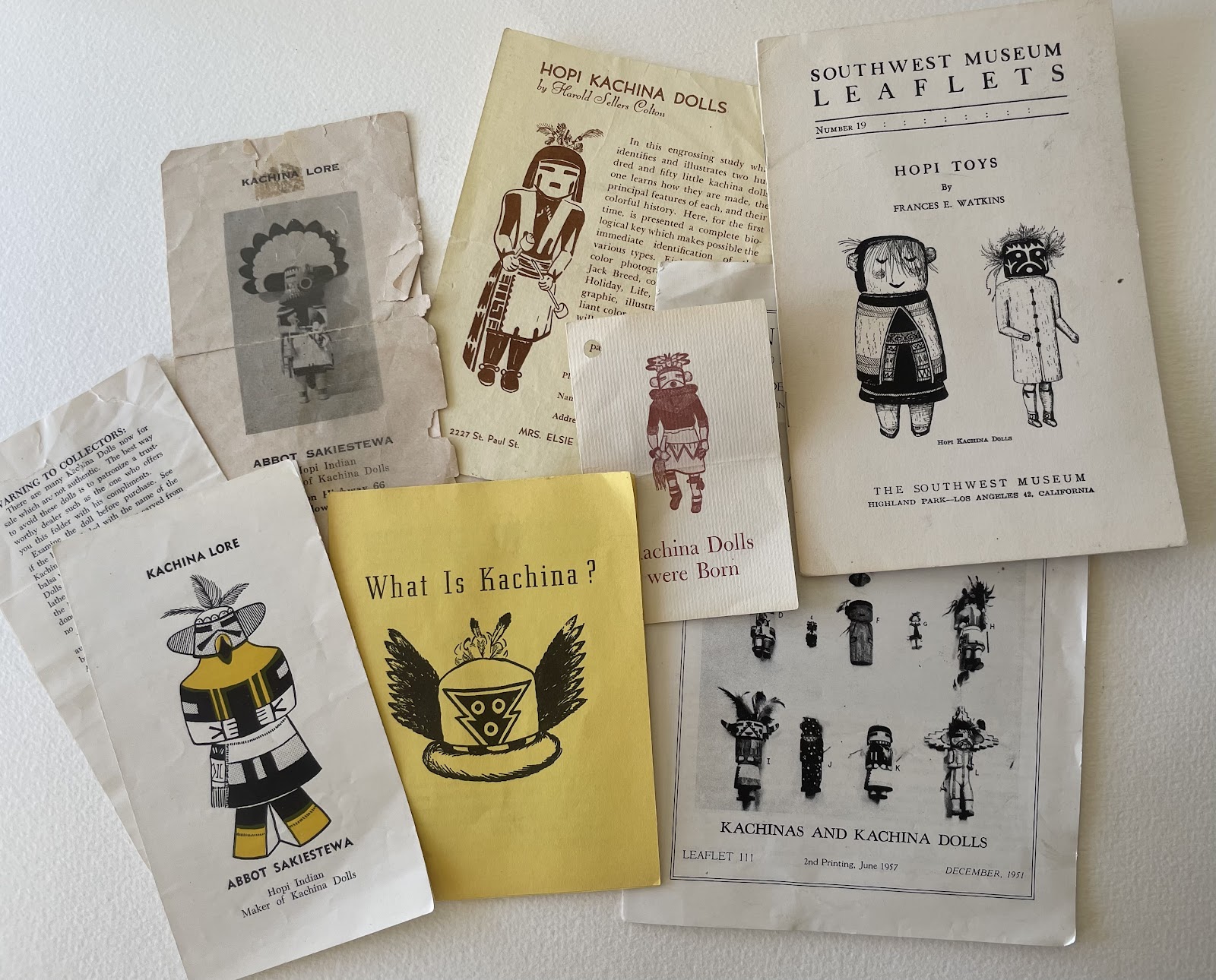
Front and back of the Abbot Sakiestewa Brochure


Primarily we think of three families of Kachina carvers working in the Route 66 style. 

The Pooley family at the Tewa Village on First Mesa are still making Rte. 66 dolls today. Abbot Sakiestewa at the Hopi Guild Workshop on Second Mesa, usually also identifiable by a SUN rubber stamp mark on the bottom. 

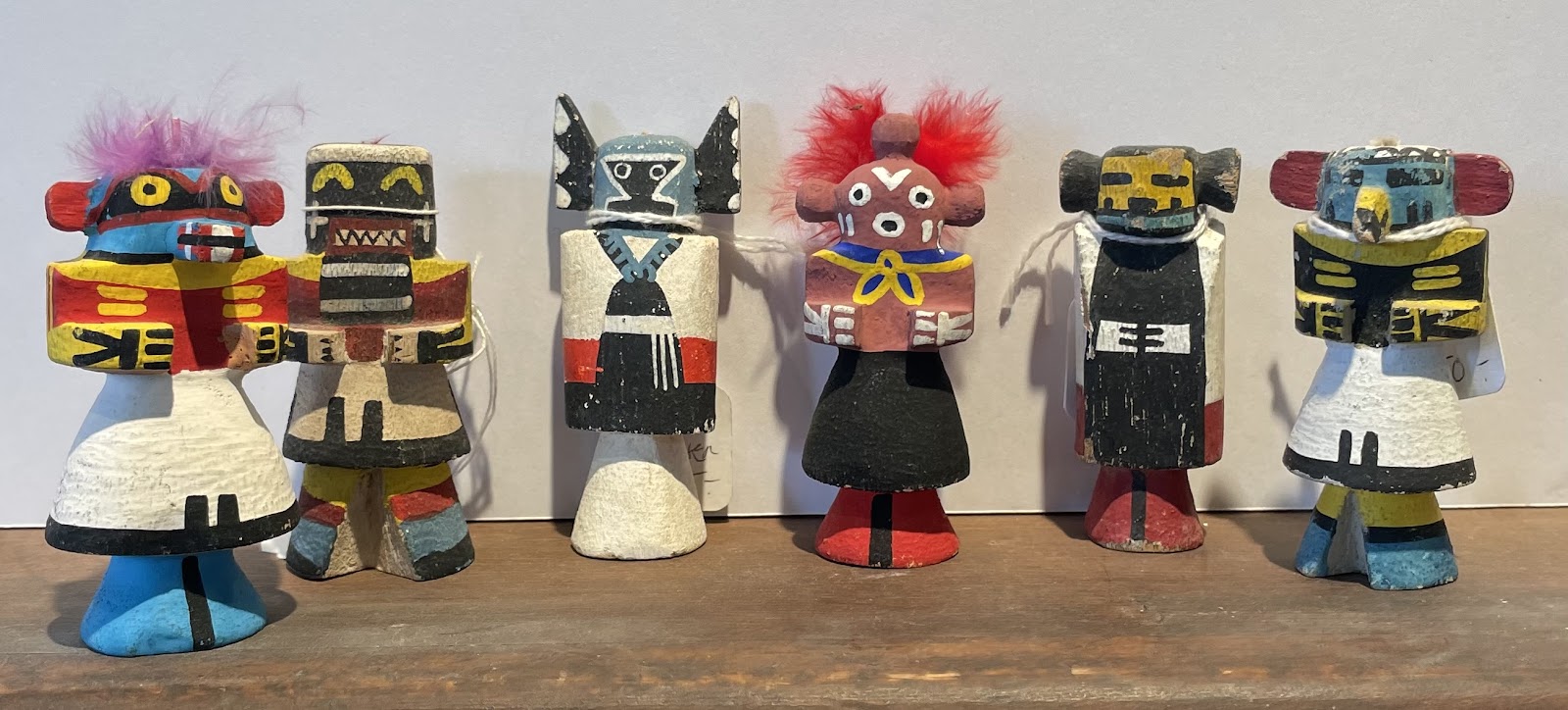
Along with Otto Pentewa of Third Mesa, whose Rte 66 dolls today may be the most cherished and valuable, identifiable by either a series of white dots or dashes as an added design element. 

Other carvers of this style remain unidentified, although most Kachina carvers would have made dolls of this style in order to make a little bit of money. 

The highly sought after carvings of Wilson Tawaquaptewa was known to carve mini carvings of dolls not quite considered kachinas but of his own design. At times he used a simplified cut cone shape with an extended flat foot for the legs of his dolls.

Pooley, Abbot, & Otto Route 66 Dolls

Comparison of Rte. 66 Dolls at bottom is one made by Otto Pentewa, at top is perhaps by George Pooley
Miniatures by Wilson Tawaquaptewa in his classic abstract style and traditional style


When I asked Gregory Schaaf, author of “Hopi Katsina, 1,600 Artist Biographies” about why he chose to not include the carvers of Route 66 type dolls. His reply was this: “While I find Route 66 dolls important to social history, I am doing a series called ‘Masterpieces of Native American Art’. I hope you can see why route 66 dolls are not appropriate for the "Masterpieces" series. Thank you for understanding my purpose.” He has published 9 volumes on various topics in his American Indian Art Series, all of which are now out of print.

Comparison of Hopi Maidens one with legs the other with an Abbot style base

Along with the Hopi makers, there were also Navajo crafts people making small wooden dolls known as Yei figures, usually out of a piece of pine (a wood easily identifiable and quite different from cottonwood used by the Hopis). These tend to be in a wider format with thin tiny noses, at times a tall tableta will be at the top of a head, these souvenirs carvings do mix well in a display with the Hopi versions.

A simple Navajo 'Yei' Currently Available Rte. 66 carving 4" tall $20.


Route 66 Kachina Dolls are truly the best format to begin a Kachina collection for their affordability, variety and availability. Some collections began as a treat for families who sought them out and chose one each time they visited the Southwest. The ability for these carvings to solidly stand in place and their diminutive size allowed them to be displayed easily (they were also easily transported in luggage). As they almost always had a hole in the top of their heads it wasn't unusual to put an eye screw in place and hang them from the family Christmas Tree. Hanging in a Christmas Tree they seem as though they are flying back to the evergreen covered San Francisco Peaks of Northern Arizona. Perhaps the most unique use of Route 66 Kachina Dolls I've ever seen was as Wedding Cake toppers.


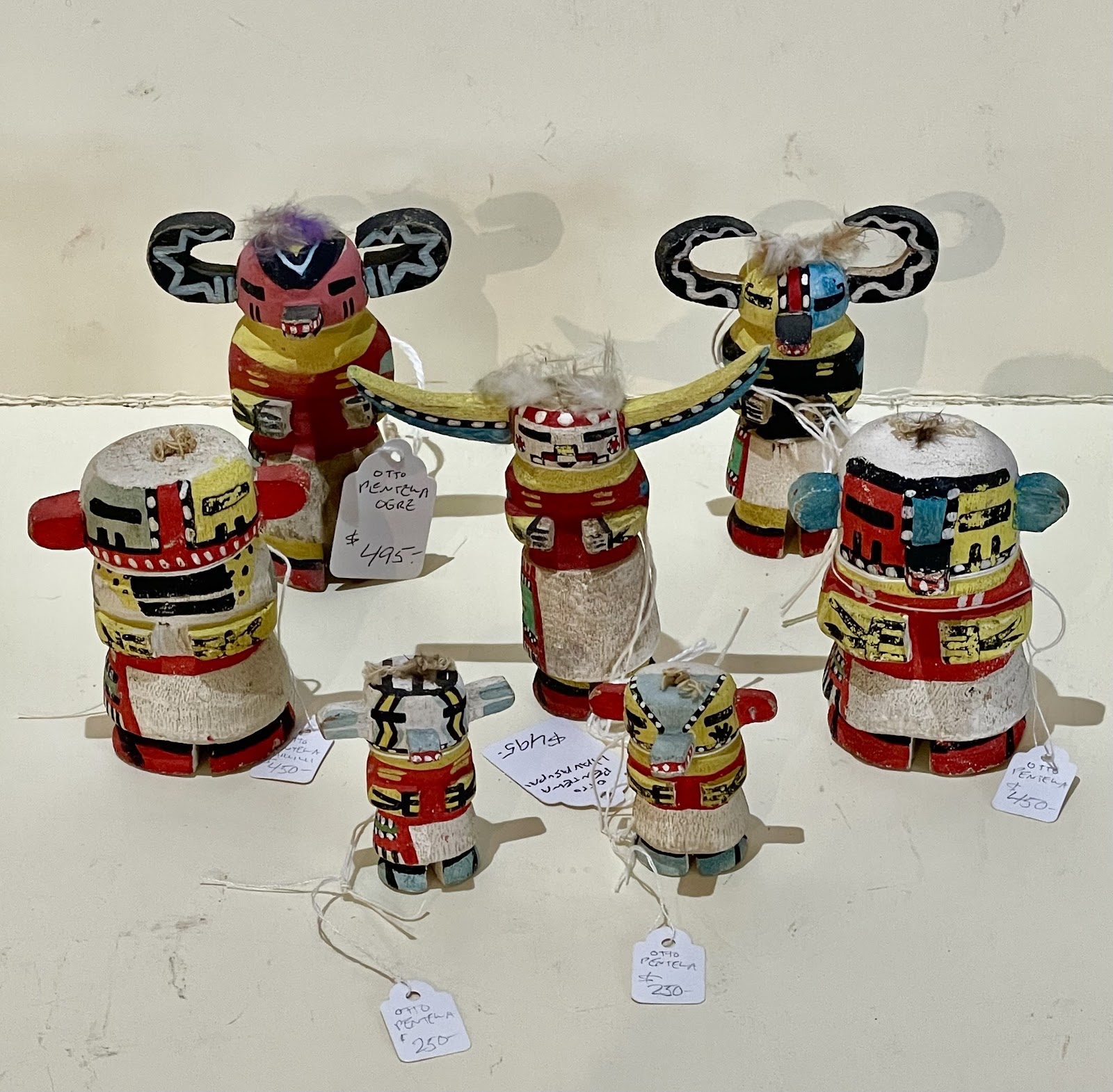
Otto Pentewa Kachina Dolls standing on a Taos Pueblo Micaceous Clay Dollhouse

An Otto Pentewa Miniature Kachina Carving 

A Group of 7 Otto Pentewa Kachina Carvings, the one at far right is available

A while back I had this interesting Otto Pentewa Route 66 Kachina Carving. 
Scratched into the bottom stating Yucca Wood, Katchina 1941
It was extremely porous and light, sold a little too quickly... 

Otto Pentewa Route 66 Kachina Dolls mounted onto mid-century modern bases which recently sold at an auction in Paris for over $1,700. each

Otto Pentewa Rte. 66 Kachina Dolls from the collection of Andre Breton

Otto Pentewa Rte. 66 Carvings the one at right is available at Two Graces, Taos 3"tall $450.

The longer I do this, the more I learn and there has indeed been much to learn about Kachina Dolls these past 21 years in business here in Taos, New Mexico. I've made note including price and size of the Rte. 66 Kachina Dolls we currently have available in the photos of this post. We do hope that you will take a look at the Kachina Dolls we offer for sale on our website at twograces.com or by following our Instagram feed @TwoGracesTaos & @KachinaRestoration

If you get a chance to be in Taos, please visit our ‘brick & mortar’ shop in the Taos Historic District at 105 Barela Lane, there is free parking in the Taos Inn lot directly behind us. Or you can call for more information and purchasing inquiries 575-770-5580




Thursday, February 27, 2025

KACHINA BOOK LIST & RELATED PRINTED MATERIAL

 KACHINA BOOK LIST & RELATED PRINTED MATERIAL 

On Collecting Kachina Dolls, Part 1 (of a seven part series)

Robert Cafazzo 

Two Graces, Taos


At some point in time you may have seen a Kachina Doll in a museum collection, at the home of a friend or in a shop. If your own curiosity was piqued and one of these carvings stuck in your head, you may have thought about purchasing one for yourself. I begin here with a list of books about all things Kachina Dolls to hopefully help educate your collecting bug and put you on the proper path to creating either a great collection or finding just one great Kachina carving. Educating yourself through images and writings in books may help you to choose a doll wisely and well informed, BUT having an actual Kachina Doll in your hands will give a better understanding of the real deal. There are many who specialize in selling these unique carvings, not everyone is a true expert, everyone gets fooled, dealers and collectors alike. The plan is to write 7 articles about collecting Kachina Dolls, most of these books will be informative to anyone interested in the carvings of Kachina. 


“The Twenty-First Annual Report of the Bureau of American Anthology” J.W. Powell 1899-1900 (63 plates of Kachinas) *

“Hopi Kachina Tradition Following the Sun and Moon” Alph Secakuku 1995 *

“Hopi Katsina 1,600 Artist Biographies” Gregory Schaaf 2008 *

“Classic Hopi and Zuni Kachina Figures” Portago & Wright 2006

“Hopi Material Culture, Artifacts Gathered by H.R. Voth in the Fred Harvey Collection” Barton Wright 1979 *

“Hopi Kachina, Spirit of Life” Dorothy K. Washburn 1980

“Kachinas: The Barry Goldwater Collection at the Heard Museum” Barton Wright 1975 *

“Hopi Clay, Hopi Ceremony” Seymour & Harriet Koenig 1976 *

“Hopis, Tewas and the American Road” Walker & Wyckoff 1983

“Kachinas” Andreas S. Andersen, Otis Art Institute 1967 *

“Kachinas, An Evolving Hopi Art Form” Jon T. Ericsson 1978

“The Great Tradition of Hopi Katsina Carvers” Barry Walsh 2019 *

“Hopi Katsina Anomalies, the Unusual, Rare and Unique” Barry Walsh 2024 *

“Dolls of the Indians, a book of Kachina Effigies” Elsie V. Hanauer 1970 *

“Clowns of the Hopi” Barton Wright 1994

“A Guide to Hopi Katsina Dolls” Kent McManis 2000 *

“Hopi” Jake Page 1994 *

"Book of the Hopi" Frank Waters 1963

"Masked Gods, Navajo and Pueblo Ceremonialism" Frank Waters 1950 *

“Kachinas of the Zuni” Barton Wright 1985

“Georgia O’Keeffe in New Mexico, Architecture, Katsinam and the Land” Buhler Lynnes & Kastner 2012

“Katsina, Commodified & Appropriated Images of Hopi Supernaturals” Zena Pearlstone 2001*

“Traditional Hopi Kachinas” Jonathan Day 2000

“Preserving a Tradition, Traditional Style Kachina Dolls” 1994 (pamphlet)

“Preserving a Tradition, Traditional Style Katsina Dolls” 1996 (pamphlet)

“Esprit Kachina” Amrouche, Rheims, Wright, Ndiaye for Gallerie Flak 2003 *

“L’Appel des Kachinas – Katsina Calling” Julien Flak 2024

“La Danse des Kachinas Poupées Hopi et Zuni dans les collections surréalistes et alentour Hopi and Zuni dolls in the Surrealist collections and around” 1998

“Les Fils du Soleil, Indiens de Californie et du Sud-Ouest” 2014 *

“Kachina, George Teriyaki Collection” Davide Manfredi 2008 *

“Kachina Figuren der Pueblo Indianer Nordamerikas aus der Studiensammlung” Horst Antes 1981 *

“Messengers of the Hopi and Zuni Gods” Geneste & Mickeler 2012

“Kachina des Indiens Hopi” Francois, Pierre & Camacho 1992

“The Stuff of Dreams, Native American Dolls” Mary Jane Lenz 1986

“Navajo Figurines Called Dolls” Kelly, Lang, Walters 1972 (pamphlet)

“Fetishes and Carvings of the Southwest” Oscar Branson 1976

“Hopi and Pueblo Tiles, an Illustrated History” Kim & Pat Messier 2007

“Kachinas in the Pueblo World” Polly Schaafsma 1994

“Kachina Dolls, the Art of Hopi Carvers” Helga Tiewes 1992

“Hopi Kachina Dolls and their Carvers” Bassman & Balzer 1991

“Kachina and the White Man” F. Dockstader 1990

“Kachinas, Spirit Beings of the Hopi” Neil David Sr. Dockstader, Ricks & Anthony 1993

“Kachinas, a Hopi Artists Documentary” Cliff Bahnimptewa & Barton Wright 1973

“The Hopi Approach to the Art of Kachina Doll Carving” Erik Bromberg 1986

“The Kachina and the Cross, Indians and Spaniards in the Early Southwest” Carroll L. Riley 1999

“Hopi Kachinas the Complete Guide to Collecting Kachina Dolls” Barton Wright 1977

“Hopi Kachina Dolls with a key to their Identification” Harold S. Colton 1949

“Kachina Lore” Abbot Sakiestewa (pamphlet) *

“Kachinas and Kachina Dolls” Denver Art Museum 1951 (pamphlet) *

“Hopi Toys” Frances Watkins (Southwest Museum) 195? (pamphlet) *

“The Hopi Indians” Ruth De Ette Simpson (Southwest Museum) 1953

“Kachinas/Saints” George Mills (Colorado Springs Fine Art Center) (pamphlet)

“This is a Hopi Kachina” Wright & Roat (Museum of Northern Arizona) 1962 (pamphlet)

“An Introduction to Hopi Kachinas” 1977 (pamphlet)

“Arizona’s First Exhibition of the Fabulous Cornell Collection of Indian Kachinas” 1973 (pamphlet)

“Nathaniel Owings’ Kachina Collection” 1973 (pamphlet)

“Collecting Kachina Dolls” Alan Kessler 1988 (spiral bound pamphlet)

“Man and Magic” 1970 (pamphlet)

“Kachina Dolls” W Ben Hunt 1957 (pamphlet) 

“Kachinas” Wayne Long 1967 (pamphlet)

“What is Kachina?” Harold Colton 1949 (pamphlet)

“Messages, Woven, Carved, Painted” 2006 (catalogue)

“The Hopi Indians” Ruth DeEtte Simpson 1953 (pamphlet)

“The Oraibi Soyal Ceremony” George Dorsey 1901 (pamphlet)

“Amerindien Precolombien 27 Juin 2014” E & Eve 2014 (auction catalogue)

“Kachina Dolls, form & function in Hopi Tithu” Breunig & Lomatuway’ma 1989 (pamphlet)

“Hopi Kachina Dolls” 1992 (pamphlet)

“El Palacio Volume 76, #4” 1970 (magazine)

“Arizona Highways, Volume XLII #8” August 1966 (magazine)

“Arizona Highways, Volume XXV #7” July 1959 (magazine)

“Arizona Highways Volume XXVI #7” July 1950 (magazine)

“Arizona Highways Volume XLVII #6” June 1971 (magazine)

“New Mexico Magazine, Kachina Special Volume 53 #3” March 1975 (magazine)


Please know that this list of over 70 books, it is in no particular order, nor is it complete. The foreign publications are quite pricey, and I have listed books about contemporary Kachina dolls as well. The pamphlets I’ve listed here are unique and rare, they are quite useful. Each time I believe I have every book about Kachinas I find another one! I have put an asterisk at the books I personally find most useful.


At any given time we tend to have a few of the books (not many) listed here available for sale at Two Graces.


Thank you for your support and your interest through 21 years in business,

R


“If you follow your bliss, you put yourself on a kind of track that has been there all the while, waiting for you, and the life you ought to be living is the one you are living. Wherever you are - if you are following your bliss, you are enjoying that refreshment, that life within you, all the time.” Joseph Campbell, The Power of Myth 1988