Showing posts with label Mabel Dodge Luhan. Show all posts

Tuesday, July 22, 2025

A Long Beard Kachina from the Collection of the Artist Max Weber

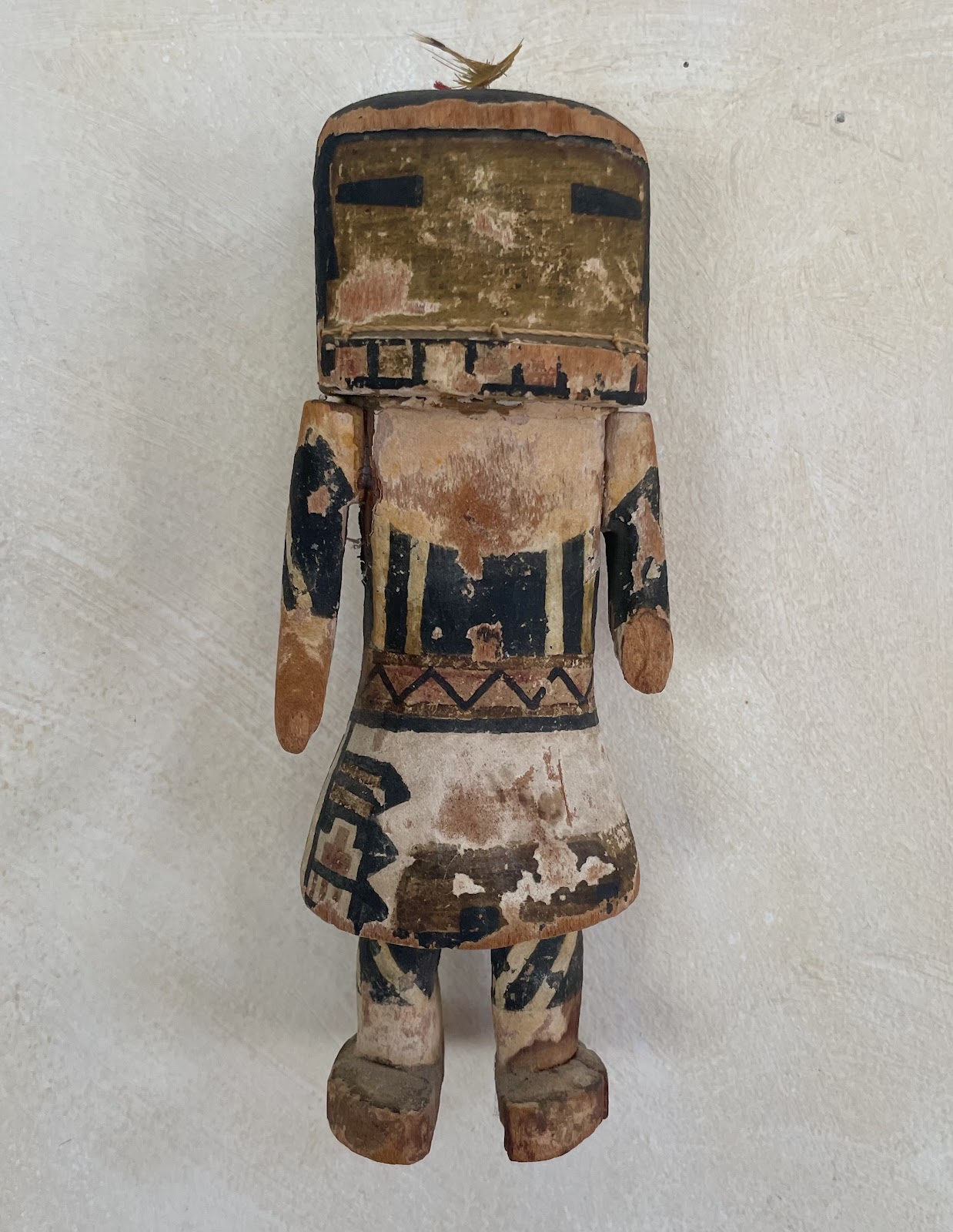
Antique Longhair Kachina Doll

Angak’china known as the First Kachina and/or the Beautiful Kachina, commonly referred to as the Long Beard, Long Hair and even Loose Hair. 

This carving is being offered to our Two Graces collectors at $9,500.*
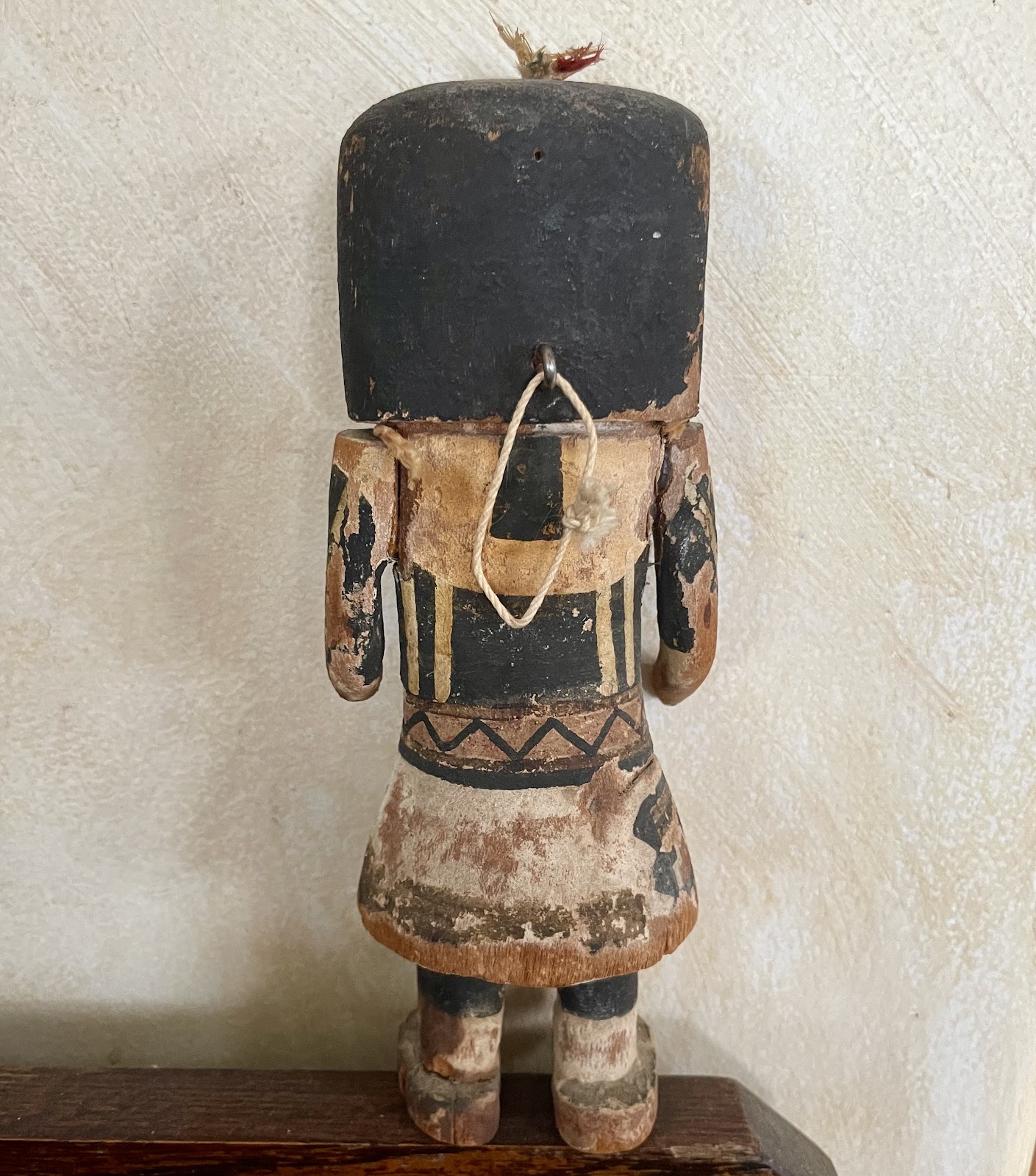
Longhair Kachina Verso

Hopi Kachina aka Katsina 8” tall  ca.1880-1910 red cottonwood root, clay, mineral paints, feathers and cotton string

Longhair Kachina Hanging on wall


The height of eight inches, is a standard size, it has a very large presence whether you have a collection of several Kachina Dolls or only this one, it is a knockout. A true American Folk Art carving, simple and well made this antique Kachina Doll will bring lasting joy to any collection.

Historic Photograph of Longhair Kachina Ceremonial Dancers


Referred to as a Volz style kachina doll carving from the time frame of 1870-1910. The trading post of Frederick Volz was located at Canyon Diablo near the First Mesa of the Hopi Villages. A large collection of these dolls were acquired by the Fred Harvey Company in 1901. Among these dolls there is a ‘dance motion’ created by the carver which this doll truly appears to have.


The deep green pigment of the face indicates an early carving, the later usage of a blue color (using a fugitive ground flora material) often fades to a soft warm grey. 


The Angak’china’s purpose is to bring rain, it is a common occurrence that during their dancing that rain will begin to fall. This of course may be due to when they dance which is typically during monsoon season. The long-beard is also seen at other Pueblo villages and is a popular entity at Zuni Pueblo. During a 1990 visit with several friends to Zuni a Kachina dance was about to take place, over fifty Longbeards along with 50 Mudhead Koyemsi Kachina figures came out into the Zuni Plaza and began to dance in the rain. I foolishly asked if the dance would take place due to the rain. Told that the point of the dance was for there to be rain, (I tend to not ask such questions any longer). The ‘singing’ (which sounded like a low hum) is meant to bring positive messages of Life to the Pueblo people.


Historic Mask of a LongHair Kachina


A Thorough Condition Report 


The loose hair represents gently falling rain, the row of various squares of colors across the lower portion of the mask representing a rainbow. The top portion of the head at the hairline is quite worn and chipped, oxidation of the cottonwood shows this to be quite old damage. Remnants of feathers, cloth(?) and string protrude from the top of the head.
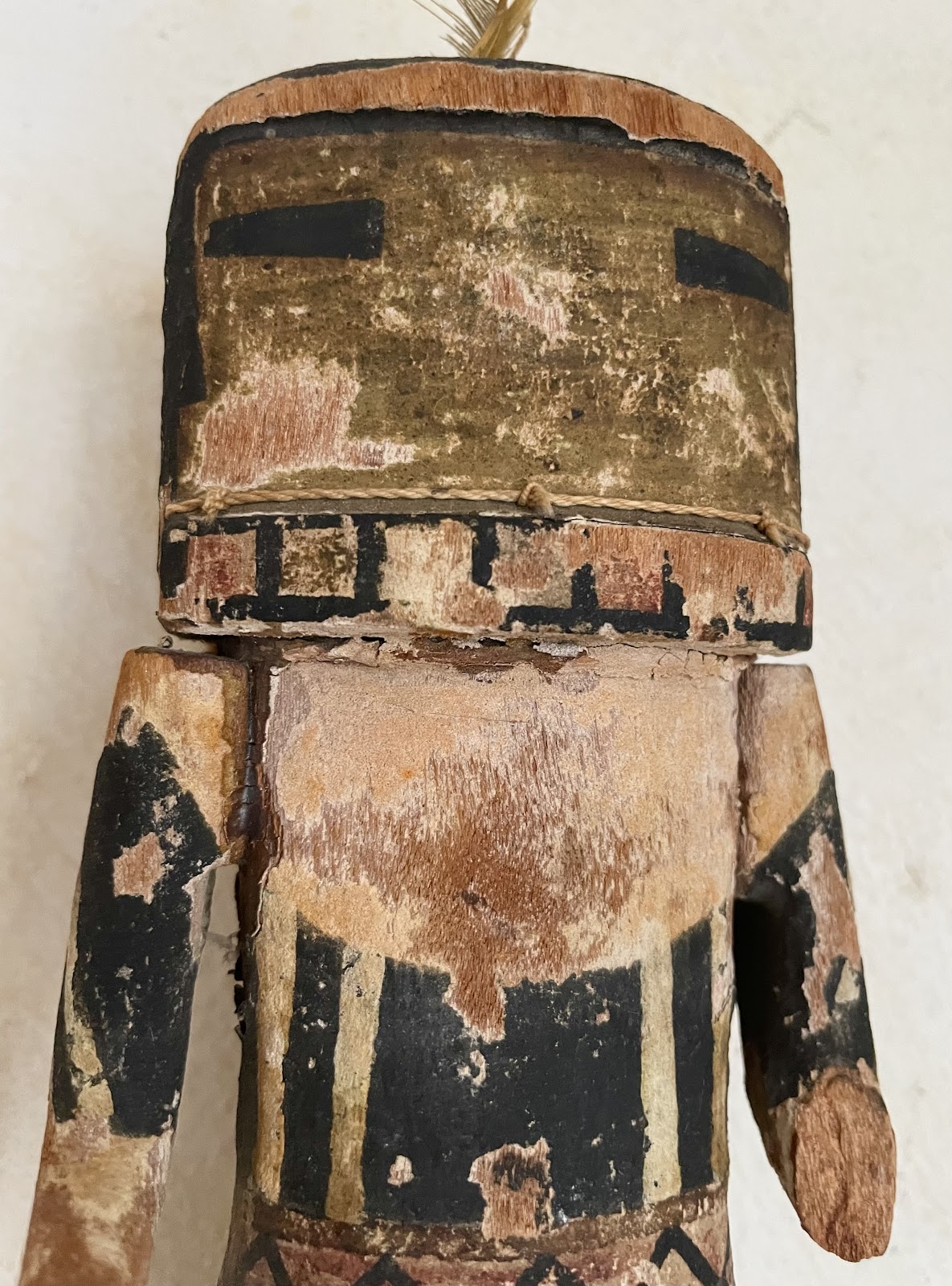
Over the missing black hair fringe (Sokum’kalmungwa) there would have been soft white eagle feathers hanging from the three knots of the string at the lower portion of the face mask. Where the beard once was the paint is very much worn from the abrasiveness of the horsehair rubbing against it. 

Overall the face mask (maskette) is painted a green known as Sakwa, usually a copper carbonite minerał paint, or a terre verde, chromium oxide, malachite. Other theories reference the mixing of a yellow ochre pigment with an indigo. Green (not blue) of the masquette is referenced in the Smithsonian publication of 1899/1900 Twenty-First Annual Report.

A cotton string was attached around the neck to facilitate hanging the doll in a Hopi home. The string and entire body of the doll was then painted over with the traditional tuma, white clay used as a wash or ‘primer’. The string at some point broke away but in the front is still embedded in the clay wash. An eye hook was put into place in order to hang the doll, probably by Max Weber.  A fresh length of cotton string has been tied in place, anyone acquiring this carving may of course remove the eye hook, however a professional restorer should be consulted.

The tuma filler at the underarm areas has worn away, but each arm is firmly attached. There is an indication of old rabbit skin glue (rabbit skin glue has a telltale brown look to it) in the armpit of the right arm. The left forearm is missing, this is an old break from being played with by the original child owner. The complete right arm slopes gently to an early version of a hand, which is sans any indication of wrist or fingers. Breakage and lost arms is common among all kachina dolls, examples of early dolls will more than likely have missing parts. If a new owner chooses to have the forearm restored this can be done by a **professional restoration person. Personally I have chosen to leave it as is.
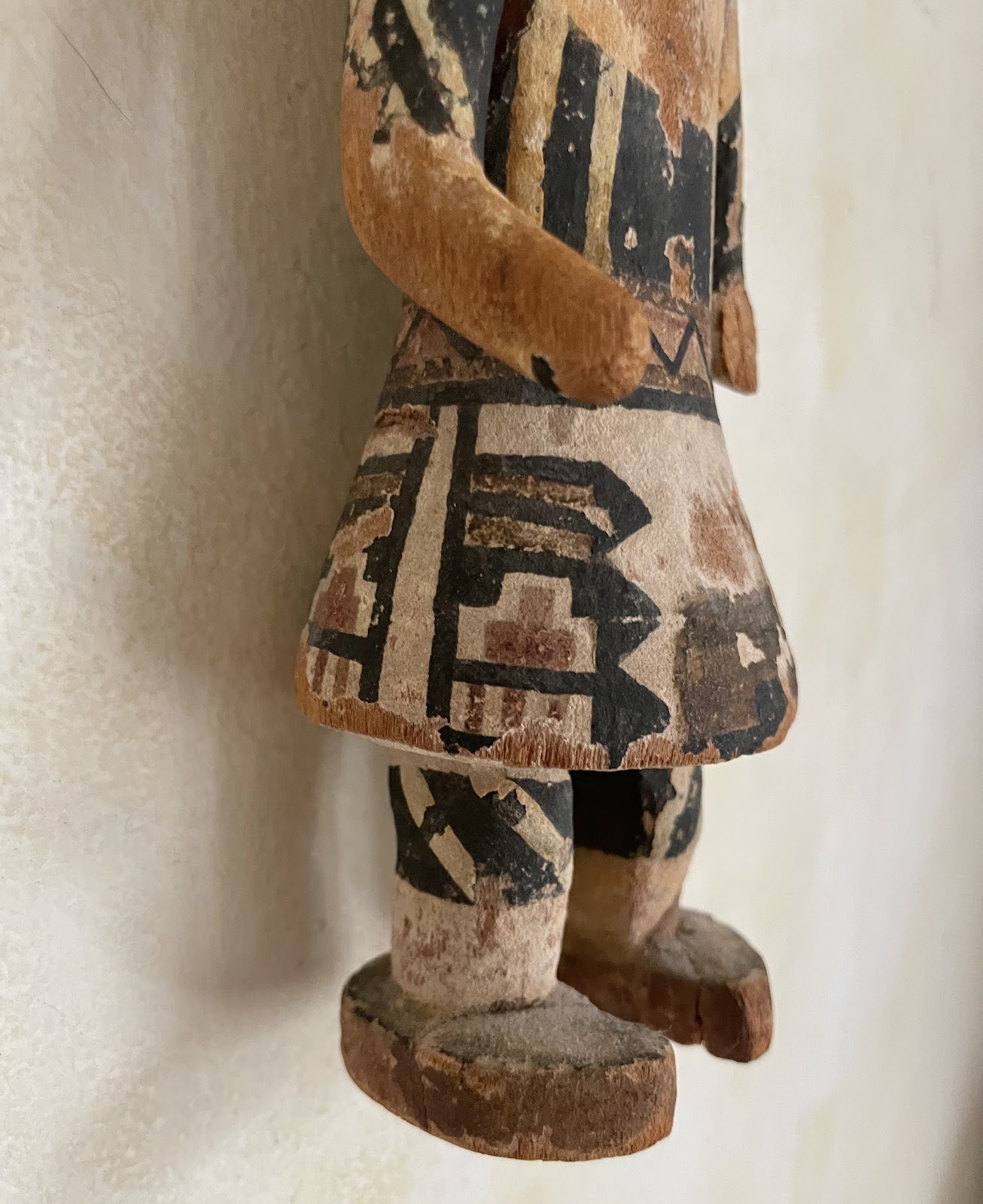
The painted zigzag or rick-rack sash at the waist is crisp with a continuous lyrical flow to it. At the right side of the kilt the classic woven design with cloud symbols has similarities to other dolls made during the time frame of 1880-1920. The kilt itself is asymmetrical, (this was pointed out to me by the only other person we’ve shown the doll to).

Which brings us to the legs, using an ochre pigment over a black coal pigment, they are painted in a delightful way with two stripes at opposing angles on each upper portion of the leg. The left foot, although not noticeable from looking at the top of it, was broken (four breaks) around when the doll was being played with. The pieces were recovered and more than likely put back into place by either the maker or family member for the child. The right foot has a hairline crack and too was repaired around the time of its origin. As any well made Hopi Kachina should, it stands solidly on it’s own. 

New information has come forward that the doll is carved of Red Cottonwood root, the red cottonwood tree once grew along the Colorado River and was the primary source for carvings until the source was over harvested. White cottonwood is what carvers switched to.

Provenance


From the estate of Joy Weber (1927-2016) Santa Fe resident, handed down to her from her father the artist Max Weber (1881-1961). 

Portrait of Max Weber

Weber was known for having brought the styles of Cubism and Fauvism to the United States. After attending the Pratt Institute of Art in Brookly, NY, in 1905 Weber went to Paris, where he continued his  studies at the ateliers of the Académie Julian, the Académie Colarossi, and the Académie de la Grande Chaumière. His early mentors, teachers and friends included Arthur Wesley Dow, Henri Matisse, Henri Rousseau, Guilliame Apollinaire, Pablo Picasso & Robert Delaunay. The ethnographic collections he saw in Europe were an influence on him as they were for many of the artists of the period. Ethnographic works were so influential on the artists in the early to mid-1900's that the Museum of Modern Art presented an entire exhibition of the artworks they inspired alongside the original material. The two volume publication for this exhibit is a vast resource, 'Primitivism in 20th Century Art, Affinity of the Tribal and the Modern' William Rubin 1984.

From 1909-1911 he became a part of the Alfred Stieglitz circle of artists exhibiting at Gallery 291. He exhibited at the Society of Independent Artists, the Whitney Museum of American Art, the Museum of Modern Art and the Jewish Museum. During the early 1920’s at the Art Students League in New York, Weber taught art classes to a prestigious ‘who’s who’ of student artists.

'Chinese Planter with Green Leaves' 1907 Max Weber
Note the Santo Domingo Pueblo style pitcher at right

'Mexican Statuette' 1910 Max Weber
Note the figure identified as Mexican is actually from Cochiti Pueblo


While in Paris, Gertrude Stein is known to have purchased a Weber painting. Weber’s Taos connection is to the Grande Dame herself, the ever influential Mabel Dodge Luhan who purchased three of his paintings in NYC. Many years later one of these paintings was included in the 2017 exhibition at the Harwood Museum  “Mabel Dodge Luhan and Company: American Moderns and the West”. His connections to Andrew Dasburg, Georgia O’Keeffe, Alfred Stieglitz, and Mabel Dodge Luhan put him in the realm of what some consider the Taos circle of artists, although it is thought that he turned down an invitation to visit Taos by Mabel and was not directly involved with any of the Taos groups he was very much aware of them. It would be best to consider him in ‘The Circle of Stieglitz’. The writings of Weber are thought to have influenced Georgia O'Keeffe in her abstract 'Infinity' studies.

Examples of Southwestern Pueblo Pottery are in a few of Weber’s still life paintings.

How, where and why Weber would have collected this particular Kachina doll is somewhat baffling until you begin to understand his deep spirituality and delve into his writing “Essays on Art” 1916. 
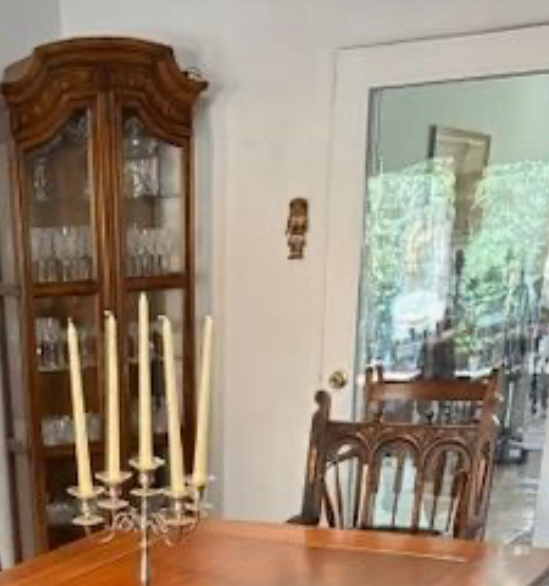
'in situ' the Kachina hanging on the wall by the cabinet of crystal in the home of Joy Weber


The collections (in particular the Cabinet of Curiosity style collections) in Europe particularly in Paris along with Museums across Europe were known to include Kachina Doll carvings. The cubist artists in particular, greatly admired carvings by the Hopi & Zuni people of the Southwestern United States.

The Photograph is of Max Weber in his studio, at top right there is a portion of what appears to be a Kachina Doll.
The size of this piece can be compared to the size of the light switch cover below it. I've added the comparison of the Weber Estate Kachina Doll as it was from the estate sale website after expanding it. Either image could be almost anything but in the case of the estate image I went with my gut and asked for a better photograph. In the case of the piece in the studio photograph we will never know if there was another Kachina doll or more in Weber's collection.

To see a thing is to see its inherent spirit… To see an artwork casually or en passant, is a very pleasant experience; but to come in touch with the vision, the spirit of its maker, is seeing in participation, and then it is not a gratification but an exaltation.

Max Weber for Photographic Art, 1916


*Due to the Provenance, Age and Condition of this carving we believe the price point to be below current value.

** Professional Restoration, means just that, this is not a do-it-yourself project. I have been restoring Kachina Doll carvings and other historic wooden items since 1981.


An example of a longhair kachina from the November 2024 Paris Auction at Qiquelo 'Les Kachinas de Leo Scheer'
(in US dollars this comes to just under $13,000.)

This carving sold through Sotheby's 2 years earlier at $10,700, in 2023
Same height of 8" tall, (no further information was given)

The carving at left, missing both forearms and it's left foot is in the collection of the Brooklyn Museum
It is 6 3/16" tall, dated 1868-1900
The carving at right is the Kachina Doll we are offering from the estate of Max Weber

'The Fisherman' 1919 Max Weber
(note the right arm and left hand grasping a pole, they are extremely similar to the hands and arms of Kachina doll carvings)

THE FOURTH DIMENSION FROM A PLASTIC POINT OF VIEW’ 

In plastic art I believe, there is a fourth dimension which may be described as the consciousness of a great and overwhelming sense of space - magnitude in all directions at one time, and is brought into existence through the three known measurements. It is not a physical entity or a mathematical hypothesis, nor an optical illusion. It is real, and can be perceived and felt. It exists outside and in the presence of objects, and is the space that envelops a tree, a tower, a mountain, or any solid; or the intervals between objects or volumes of matter if receptively beheld. It is somewhat similar to color and depth in musical sounds. It arouses imagination and stirs emotion. It is the immensity of all things. It is the ideal measurement, and is therefore as great as the ideal, perceptive or imaginative faculties of the creator, architect, sculptor, or painter. Two objects may be of like measurements, yet not appear to be of the same size, not because of some optical illusion, but because of a greater or lesser perception of this so-called fourth dimension, the dimension of infinity. Archaic and the best of Assyrian, Egyptian, or Greek sculpture, as well as paintings by El Greço and Cézanne and other masters, are splendid examples A Tanagra, Egyptian, or Congo of plastic art possessing this rape sualtof a Canagra, Fee, anile ongo, mediocre piece of sculpture appears to be of the size of a pin-head, for it is devoid of this boundless sense of space or grandeur. The same is true of painting and other flat-space arts. A form at its extremity still continues reaching out into space if it is imbued with intensity or energy. The ideal dimension is dependent for its existence upon the three material dimensions, and is created entirely through plastic means, colored and constructed matter in space and light. Life and its visions can only be realized and made possible through matter. The ideal is thus embodied in, and revealed through the real. Matter is the beginning of existence; and life or being creates or causes the ideal. Cézanne's or Giotto's achievements are most real and plastic and therefore are they so rare and distinguished. The ideal or visionary is impossible without form; even angels come down to earth. By walking upon earth and looking up at the heavens, and in no other way, can there be an equilibrium. The greatest dream or vision is that which is re-given plastically through observation of things in nature. "Pour les progrès à réaliser il n'y a que la nature, et l'œil s'éduque à son contact." (*For progress to be made there is only nature, and the eye is educated through contact with it). Space is empty, from a plastic point of view. The stronger or more forceful the form the more intense is the dream or vision. Only real dreams are built upon. Even thought is matter. It is all the matter of things, real things or earth or matter. Dreams realized through plastic means are the pyramids and temples, the Acropolis and the Palatine structures; cathedrals and decorations; tunnels, bridges, and towers; these are all of matter in space-both in one and inseparable. 

Max Weber for Camera Work 1916

The treasure hunt of finding such a magnificent Hopi Kachina Doll has been thrilling

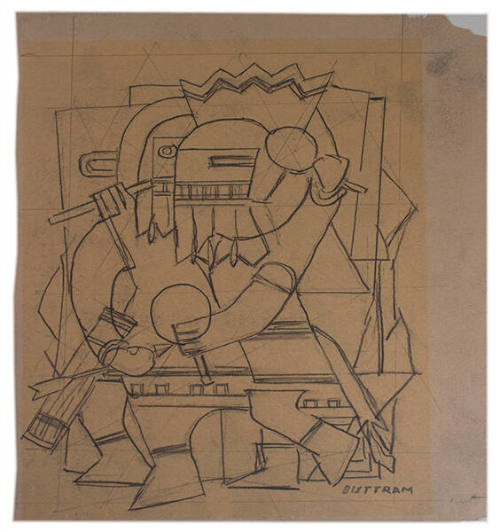
Hopi Kachina, Coyote Claw (Long Beard Kachina drawing study for painting) 1934 Emil Bisttram

The need to explore primitive and American Indian art by Abstract Expressionist painters during the 1940s is well documented. Less known is the interest in American Indian art manifested by earlier painters such as Max Weber, Marsden Hartley, and John Sloan. Their interest has been overlooked because such art was not central to the formulation of their styles, nor did they write about it with the degree of urgency exhibited during the 1940s. In fact, except for a few words about Hopi katchinas mentioned by Max Weber in 1910, American Indian art did not receive serious attention until about 1920. Nevertheless, attitudes concerning primitive art, and values found therein, provide us with important insights into the artistic motivations of the early modernists. 
Modem Uses of American Indian Art Matthew Baigell 1976


Tuesday, June 28, 2016

Mabel Dodge Luhan & Company, Harwood Museum of Art, Taos

American Moderns in the West
Nicolai Fechin "Portrait of Mabel Dodge Luhan"

A tour...
The Mabel Dodge Luhan House as it is a B&B and Conference Center today in Taos

“Dear Mabel,
It is 5am…
It seems so perfect that I wonder…
Is it just a dream I make up…”   
Georgia O’Keeffe
The 'Pink House' today under private ownership, 
where Georgia O'Keeffe and Rebecca Strand stayed on their first trip to Taos.

This exhibition opened here in Taos the weekend of May 22, 2016 it closes on September 11, 2016 (D.H. Lawrence’s Birthday by the way), it will move on to the Albuquerque Museum and later to the Burchfeld Penney Art Center.
Paul Figueroa speaking eloquently at the opening

I was so excited before even seeing the exhibit, that we became members of the Harwood Museum in order to attend the Members opening. (That’s saying a lot for me, as I’d been boycotting the Museum for years due to the turmoil involved with the former Director). The Museum now has a terrific new director Richard Tobin, the staff is beside themselves happy these days and so am I, a marked difference. At this time the exhibit has been open for less than 5 weeks, I've been to see it FIVE times already (and that's with being gone from Taos for 2 of these past 5 weeks).
At the opening 3 of the very best people who also happen to be docents at various Museums in Taos today. 
Holly Sievers, Charlene Tamayo, Lucille Greider.

“One does not get better but different and older and that is always a pleasure.” 
Gertrude Stein
William Penhallow Henderson "Interior, Mabel Dodge Luhan House"

The entire Museum is dedicated to works on display for this exhibition, (the Agnes Martin room is still its own entity as well as the Ken Price room, and the new acquisitions gallery) an enormous commitment. The payoff is that it is simply the best exhibit this Museum has done and the crowds of people visiting is proof.
Marsden Hartley "An Abstract Arrangement of American Indian Symbols"

“I found out that the sunshine in New Mexico could do almost anything with one: make one well if one felt ill, or change a dark mood and lighten it. It entered into one's deepest places and melted the thick, slow densities. It made one feel good. That is, alive.” 
Mabel Dodge Luhan
left: Marsden Hartley "New Mexico Recollection 12" & "Rio Grande River, New Mexico" 
right: Beatrice Mandleman "Twining"


Jacques-Emile Blanche "Portrait of Mrs. Mabel Dodge & Son"


Although there is a timeline provided, Head towards the giant portrait of Mabel and son John Evans by Jacques-Emile Blanche and start in the far back gallery space at the early Marsden Hartley painting, I gasped as I entered the room (the room has an enormous Louis Vuitton suitcase in the middle of it) as you turn towards the next wall to your right there is a lovely drawing by Maurice Stern (husband #3) of Mabel herself. Maurice Stern came to Taos before Mabel, at her suggestion. I’ve not seen much of his artwork other than a few drawings, one of which is a beautiful Fawn at the Barnes Foundation in Philadelphia
Maurice Stern "Mabel Dodge"

“It takes a lot of time to be a genius. You have to sit around so much doing nothing, really doing nothing.” 
Gertrude Stein

For some time now the Harwood has displayed a still life painting by Mabel, it is absent from this exhibition, I’d asked one of the curators early on if they would be showing some of her paintings, they chose not to. Personally, I’d like to see a few of her other paintings. 
Mabel on Horseback with Mr. Concha, private collection photo

“Don't everlastingly read messages into paintings – there's the Daisy – you don't rave over or read messages into it – you just look at that bully little flower – isn't that enough?” 
John Marin
Andrew Dasburg "Chantet Lane"

The front space gallery has a selection of Andrew Dasburg paintings, all 5 are exquisite. Recent research by the wonderful historian Liz Cunningham reveals that the “Chantet Lane” 1926 painting is of Jeantete Road. Well there was no true road signage around Taos (until the 60’s), which means if you’d only heard the name spoken you might get the spelling of it wrong. Or, did Dasburg choose to misspell the name on purpose to mislead other painters away from his site, (my speculation). Dasburg also was THE dealer of vintage 'Santos' the Bulto Carvings and Retablo Paintings of Hispanic Artists (the Barnes Foundation has one of the best collections I've seen outside New Mexico thanks to Dasburg).
Five paintings by Andrew Dasburg, to the far right is "Chantet Lane

“You've got to know yourself so you can at last be yourself.” 
D. H. Lawrence
A few of the John Marin works

The Harwood’s grand gallery features the O’Keeffe’s, the John Marin’s, a pair of Diego Rivera drawings (to me looking quite out of place), and a tribute to D.H. Lawrence along with many other rich and beautiful artworks. A surprising choice to include 2 deer watercolors by Knud Merrild who Mabel truly disliked for his being a distraction to Lorenzo. I love that these paintings are included!
"Deer" Knud Merrid

“An artist is only an ordinary man with a greater potentiality.” 
D. H. Lawrence
Dorothy Brett "My Three Fates" (Mabel, Frieda, Lorenzo, Brett w 'Tobey')

Upstairs the displays feature paintings of some of the religious items and paintings of Spirituality, Catholic/Hispanic and Pueblo ceremonies. Again some true jewels upstairs in the 2 rooms there. The Indian School paintings by various artists along with Dorothy Brett’s paintings of ceremonies are treasures to see side by side. The Hispanic Retablos (and Bultos) frame some of the works by the Taos & Santa Fe School Modernists, together complimenting each other, playing off each other, honoring each other. The exhibit gives the Honourable Dorothy Brett a nice place in this piece of the Modernist Taos Art Colony. She has been one of the most underrated of the Taos painters for many years, I hope her time is coming, soon.
Part of Mabel's 30 piece Retablo Collection, at center Marsden Hartley "Blessing the Melon"

“The artist's world is limitless. It can be found anywhere, far from where he lives or a few feet away. It is always on his doorstep.”
Paul Strand
4 Masterworks by Paul Strand

Scattered throughout the galleries are photographs by Paul Strand, Laura Gilpin, Ansel Adams, Edward Weston, Alfred Stieglitz, Carl Van Vechten, John Young-Hunter, Rose Clark, John Collier, Marjorie Content, Ernest Knee, Dorothea Lange, Sonya Noskowiak & Henri Cartier-Bresson (who am I missing?). The breathe of the photographers alone would be a masterworks exhibition in its own right! Again, I remind you, they are scattered throughout, please take the time to look.
Ansel Adams "Eagle Dance, San Ildefonso" & Awa Tsireh "Eagle Dance"

“In wisdom gathered over time I have found that every experience is a form of exploration.” 
Ansel Adams
Rebecca Salsbury James "Walking Woman, Taos"

The other day I was docent at the D.H. Lawrence Ranch (I’m President of the Board of Directors for the D.H. Lawrence Ranch Alliance), a woman came up to visit. She told me she’d just been to the Harwood to see the exhibition. One of the Harwood Staff members told her that the ranch was open to the public that day (10AM- 2PM), then and there she decided to stop her viewing of the Mabel Exhibit and drive up to the ranch. I showed her around for a tour afterwards she then return to the Harwood to continue her enjoyment of the Mabel exhibition. I am in awe of how this exhibit is creating such terrific synergy all around Taos. All of the Lawrence Ranch docents mention to visitors that a visit to the Harwood is a must.
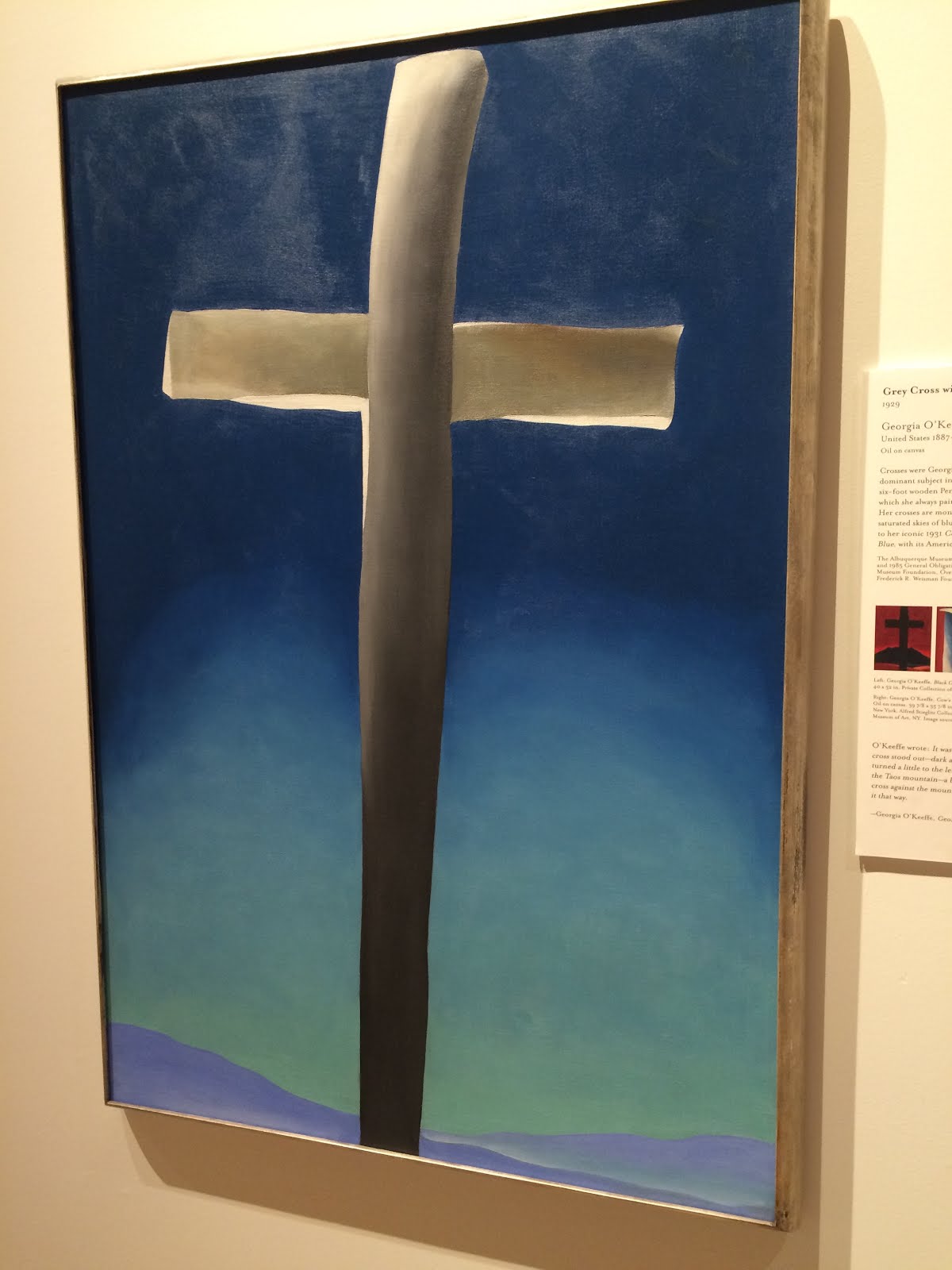
Georgia O'Keeffe "Grey Cross with Blue"

“What a life, seeing!” 
John Marin
Paul Strand "Marin Working Near Twining"

It seems of late there’s a lot of synergy around exhibition retrospectives featuring women or their circles, Agnes Martin, Georgia O’Keeffe, Women of Abstract Expressionism and here in Taos, Mabel & Co. I teasingly, lovingly say to women friends, what the heck is up with all these women overshadowing all the men lately??? Well, it’s about time. A few years ago in Taos there was a promotion of “Remarkable Women of Taos”, this may have been a prescient town wide honoring of women that got the ball rolling.
Docent tour of the exhibition 

“Do what you feel in your heart to be right, for you'll be criticized anyway.” 
Eleanor Roosevelt 

My personal sanctuaries are Museums and the forest, both are inspiring and nurturing. Visit Taos before September 11, 2016 or you’ll have missed a treasure chest of inspiration and loveliness right here in the place Mabel chose to call her home.
Emil Bisttram "Creative Force"

“Love art. Of all lies, it is the least untrue.” 
Gustave Flaubert
Agnes Pelton "The Voice"

This is a very small glimpse of the exhibition which will change as other works become available and as it moves to the other 2 museums scheduled at this time.
Georgia O'Keeffe "Taos, New Mexico"

Purchase the catalogue (which I have yet to do), “Mabel Dodge Luhan and Company, Moderns in the West” in hardcover. My gratitude to the curators Lois Rudnick and Ma-lin Wilson-Powell, along with all of the staff at the Harwood Museum. You should all be quite proud of this accomplishment, congratulations. http://www.harwoodmuseum.org/exhibitions/view/147

Portrait of Mabel Dodge Luhan, private collection