Tuesday, December 13, 2011

Emil Bisttram (April 7, 1895-1976) Abstract Works on Paper

Quite recently I was in the right place at the right time when a portfolio of the artwork of Emil Bisttram was offered to me. I recognized the drawings to be of quite extraordinary quality and beauty, a rare opportunity to own such a grouping.
In my research I have discovered a bit more to this, (I continue to learn more about Bisttram and this collection).
The Bisttram estate was donated to St. John’s College in Santa Fe. Most of the contents of the house were gathered up, put onto a truck and brought to Santa Fe from Taos. The artwork was at first turned over to the Gerald Peters Gallery and a short time later sent to the Munroe Gallery where it was stored in a room in the Santa Fe railyard district and piece by piece appraised and sold by James Parsons of Taos (from 1986-1989) who authenticated the unsigned artwork. Mr. Parsons also created a signature/logo stamp, which he used on this body of work from the estate.
Mr. James Parsons (1930-2013), lived in Taos, came to look at this portfolio here at my gallery in Taos, Two Graces. 
He and his appraiser friend Phillip Bareiss (1949-2026) also in attendance, exclaimed simultaneously ‘wow those are some great Bisttrams’. *These 2 gentlemen have also given me a wholesale appraisal estimate for resale. He is an authority on the artwork of Bisttram, Jim was a consultant on the books ‘The Transcendental Art of Emil Bisttram” by Walt Wiggins (1988) and “Emil Bisttram 1930-1976” by Warren Shaull, James Parsons, Bernard Ewell & David Witt (2003). This body of artwork is thought to be circa mid 1950’s to early 1960’s.

In a 1954(?) Family Circle magazine article on Taos Artists I found this photo of Emil Bisttram in his studio, (above) pinned onto the wall behind him lined up in a row are drawings similar to the B&W work in this group. Although, I cannot say with certainty that any of these are the same exact drawings in the picture, I am convinced this is from the same body of work.


The technique used here is black ink has been painted into a rectangular field, onto a heavy paper and drawn onto with what we think to have been a white china marker or conte crayon. In the margin, (they have about 2” margins all around) one of these has a small hand drawn diagram in the margin at the bottom, Bisttram’s thought process. The B&W field on these is about 9” x 12”, with the paper around 14” x 16”, all are unsigned.

The accountant (who became the unofficial de-facto executor to the estate of the Bisttrams) gathered up the items left behind by the college, (this woman was not just an accountant, she was a trusted and dear friend). It is from the family of this accountant that this portfolio was acquired. Along with this portfolio of Bisttram works on paper, there are also commissioned poster studies by Bisttram, artwork by local Taos artists, drawings by his students, unused zinc plates for lithography (still wrapped in paper from the day he had purchased them) and a pencil drawing of “Dynamic Symmetry” (also referred to as “Designed Reality) on tracing paper. When placed over some of the artwork this drawing matches the shapes and designs Bisttram created here, as someone recently said to me this is the ‘golden mean’. In 1930 a Guggenheim Fellowship gave him the opportunity to study with Diego Rivera in Mexico, there Emil would have learned of this grid technique. Rivera called it the “Golden Section”, sometimes referred to as “Divine Proportion”. It is explained that this mathematical ratio was thought to have spiritual powers.

The single circular pencil drawing is larger than the other work and is from the time period of his masterwork painting “The Oversoul”. This theme continues in drawings known as “Kundalini”, “Atonement”, & “Creative Forces”, this piece is unsigned, it is Sold.

One of Bisttram’s friends would meet him regularly for coffee in a local Taos Plaza coffee shop at one time he remarked that Emil would be better off making the more realistic artworks which sold quite well and popular with the art buying public, rather than this new ‘abstract’ and not necessarily as popular body of work, to which Bisttram replied, ‘this was his real artwork and his true calling’.
Avanyu Cloud, pastel on paper
(24" x 20" framed)

Sold
Sold

Sold

Sold
                                                                               Sold

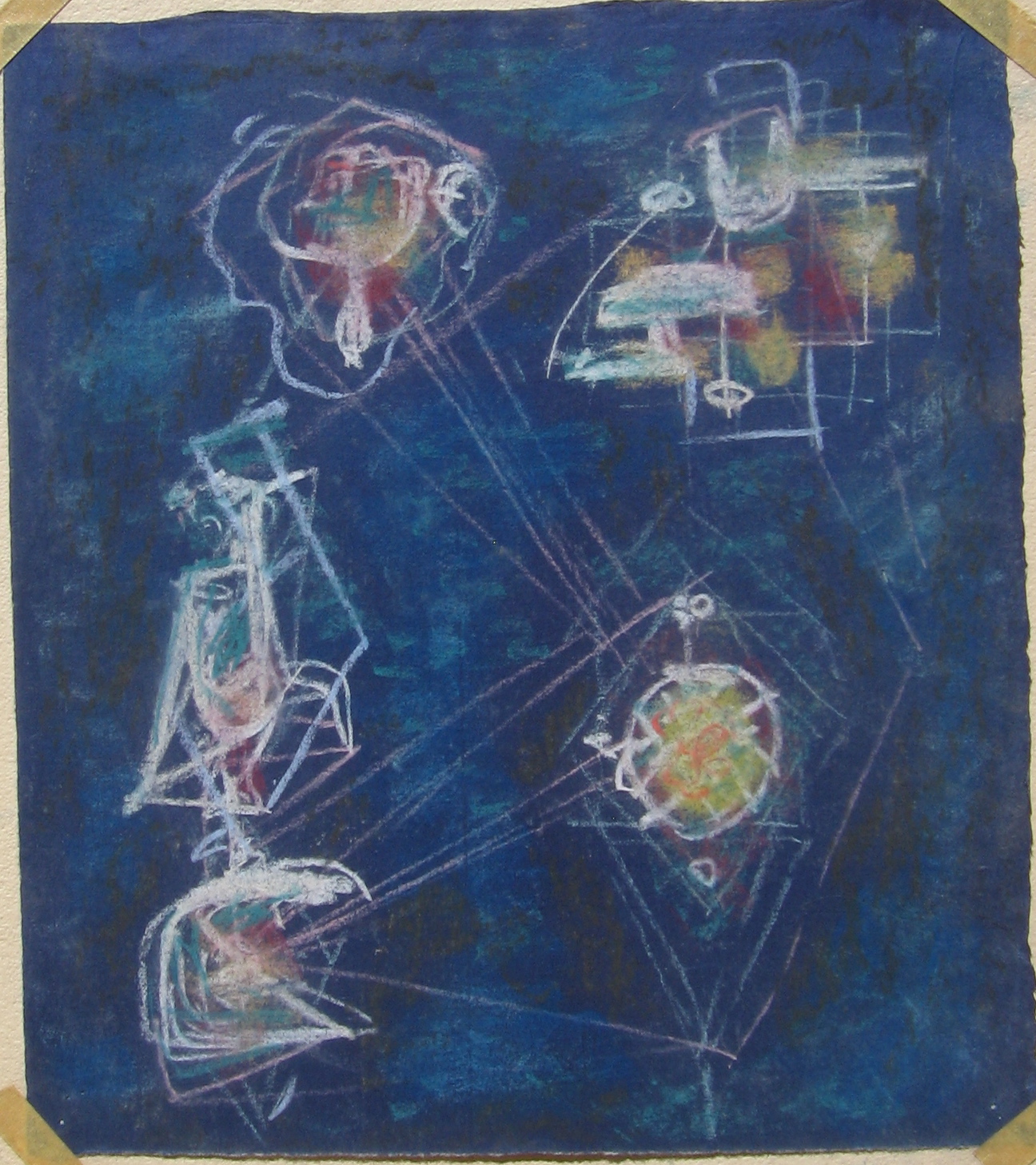
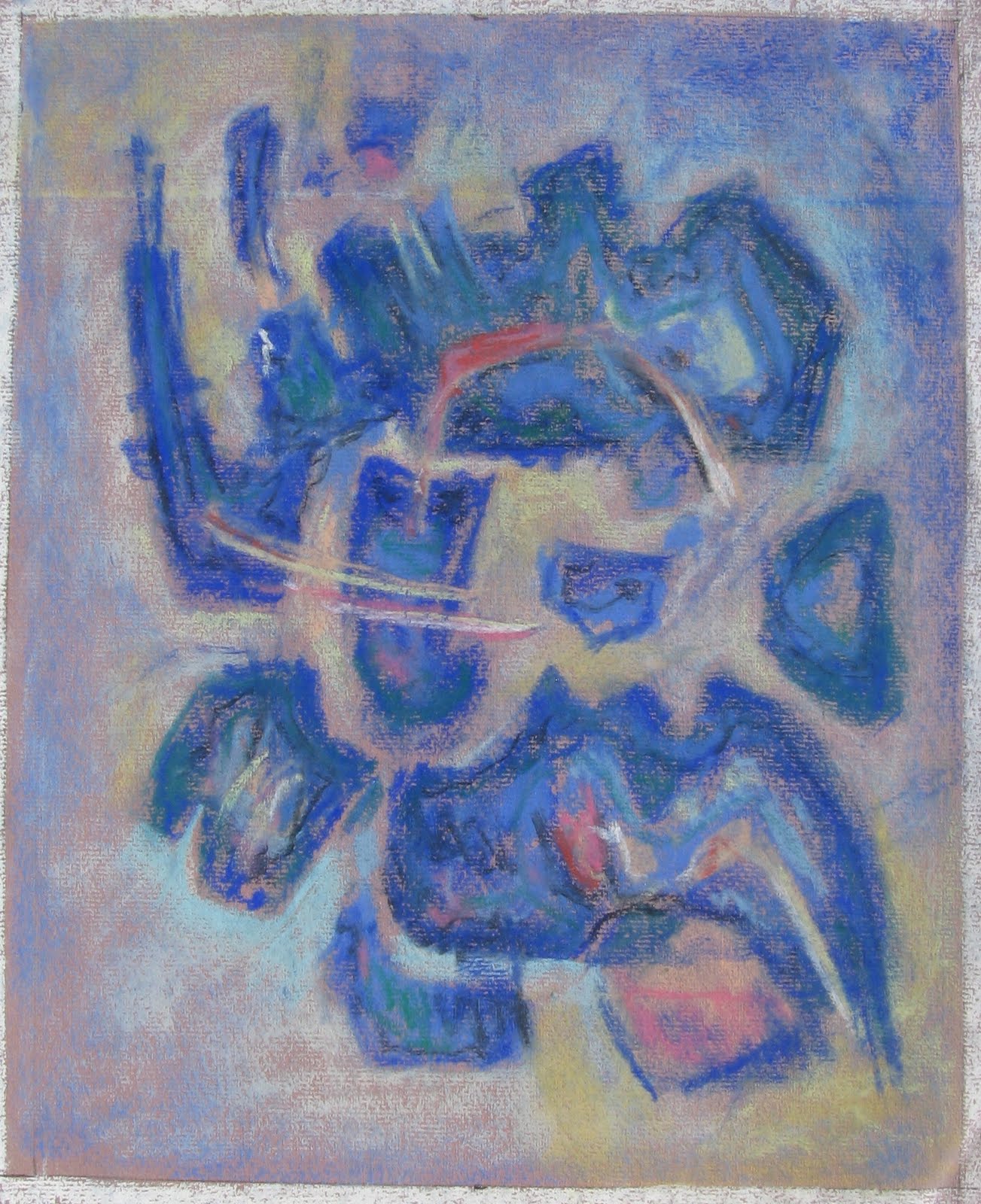
This group of colorful abstract chalk pastels is in the range of 9” x 12” only with a smaller border of about 1” around. These images range in subject matter from a landscape, dynamic symmetry examples, the amoeba-like musical notation, and abstract Shalako Kachina heads, all are unsigned.

In order to make ends meet he created his own art school The Taos School of Art, renamed in 1943 the Bisttram School of Fine Art, he also taught through the University of New Mexico Summer Arts Program, and at an art school in LA from 1945-1951 during the Winter. Bisttram was also involved with starting one of the earliest art galleries here “Taos Heptagon” along with a Taos Artists Society. 1938-1942 he was also a member of the Santa Fe “Transcendental Painting Group”, which promoted abstract painting.
Sold

Sold

Sold

The oddest pieces here in this collection are the poster designs, which are on illustration board and done in watercolor, quite beautiful in their own right, again something probably done to earn some money.
Sold

Sold
Sold

Sold

Sold

Along with the original Bisttram’s are a group of Portrait and Figure drawings from one of his art classes. These are matted and signed by the students, it is my deduction that these were matted to have them displayed in a student group show as an exhibition to celebrate the end of that semester. One drawing in particular of a figure, has a smaller figure drawn on the lower right side, which from my own experience in art school would have been drawn by Bisttram himself to demonstrate his point to a struggling student searching for the best way to depict the figure. This tends to be the way most figure drawing teachers teach, thus a jewel of a Bisttram sketch appears along with this particular students drawing. These student artists include works by: Bob Burke, M. Tuttle, W. Jimenez, Gendron Jenson, Marilyn Wood, F.B. Coffman & Bob Matz. Another aspect of this group of drawings is that in the book “Modernists in Taos, From Dasburg to Martin” by David Witt on page 64 a photograph of the Bisttram school of art shows students at easels with the student in the center of the photo painting a portrait of the very same Hispanic gentleman that is included in this portfolio.
Today in the market place it is thought that there are many forged Bisttrams. It is my belief that this is untrue, that actually there are forged signatures on real artwork, because much of the 3,000 pieces of art that Bisttram created had never been signed by him and that he tended to sign things as he sold them and not before. An artist as prolific as Emil Bisttram would be making some great work and some not so great artwork at this level of output (during almost 60 years). The signature of Bisttram is almost always a simple block printed last name, which would be extremely easy to recreate, (thus forge). In a local gallery (now long gone) there was a pastel drawing, which is signed with a script signature. When I inquired about this, the gallery owner told me this particular piece had come from the estate of Helene Wurlitzer who had purchased it herself directly from Mr. Bisttram.

With Taos being one of the oldest art colonies in the US and with the amount of truly talented artists who have lived here over the last 100 years it is not unheard of for some of the artwork created here to turn up every now and then. I’ve seen paintings by the Taos Founders (aka The Taos Society of Artists) stored under the bed of a local Taos resident!
The Bisttram House, located directly west of the Harwood Museum, built in 1936 at the same time as the library building of the Harwood.

*If you are interested in making a purchase, please contact me at r2c2graces@gmail.com or 575-770-5580

The B&W's were purchased by the Taos Harwood Museum with a generous benefactor's gift.
The tracing paper dynamic symmetry drawing is being donated to the Taos Harwood Museum as part of the arrangement with the benefactor & Museum. We are thrilled that these artworks will go to a local Taos Museum, especially that the Harwood is directly next door to the former Bisttram Home. 

Friday, November 18, 2011

Food: Pumpkin Pie

It's almost Thanksgiving!
My family celebrates this sort of Holiday with a lot of guests and a lot of food, plenty of leftovers of all sorts. My friends would tell you that Holiday meals at my Mom or Grandmothers house meant plenty of food, but even more so DESSERT! Whether we were at home or at one of my relatives homes there was always enough dessert to fill an entire banquet table. Many of my Grandmother's recipes were not written down, she would just measure the ingredients with her hand and eye. At some point my Mom started actually measuring out what her Mom was doing and was able to create an archive of her favorite recipes. At one time I made this recipe using fresh steamed Pumpkin, I didn't mash it enough so the pie was rather lumpy, my Mom just laughed about it, but it was delicious and there were no leftovers for the next day!
So with my Family in my thoughts this Holiday I share with you this recipe.

PUMPKIN PIE
Turn your oven to 400, when you put the pie into the oven lower the temperature to 375, it should take about 1 Hour to cook, in Taos at 7,200 feet this takes a bit longer.
(Grandma's trick was to always start the oven very hot)
2 1/2 Cups Pumpkin (mashed)
1/3 Cup Maple Syrup
1 1/2 Cup Sweetened Condensed Milk
2 Eggs
1/2 Teaspoon Vanilla
1/4 Cup Brown Sugar
1 Teaspoon each of Cinnamon & Ginger
1 Pinch of each Salt, Nutmeg, Allspice, Clove, Mace
Mix this together and pour into a pie pan that you have put a pie crust into.
I use a rather large pyrex glass pie pan. If you have too much batter don't waste it, just pour it into a couple of ramekins, and bake these too!

We prefer a pie crust made with half Butter and half Shortening such as:
1 1/2 Cups Flour
Pinch of Salt
1/6 Cup Shortening
1/6 Cup Butter
3-4 Tablespoons ice cold Water
If you've never made pie crust before this is rather straight forward and not very difficult, do this first wrap it up and put it in the fridge until you're ready to roll it out and put it into your pie tin. I roll it out onto parchment paper to make it easier to transfer to the pan.

A perfect pumpkin pie does not crack, but if it does don't worry just enjoy how delicious it is!


Saturday, November 12, 2011

Two Graces Fall into Winter Tour 2011


Yahoo Travel 10 Great Mountain Towns By Jamie Moore Taos, New Mexico This Southwestern town, in a high desert valley, is a study in contrasts. Rich blue skies meet an arid countryside dotted with adobe dwellings and the Taos Pueblo village. The Sangre de Cristo Range towers majestically above the desert floor. And the Rio Grande's whitewater cuts a deep gorge in red sandstone below. Is it any wonder Georgia O'Keeffe, D.H. Lawrence, and countless others have been inspired here? 
Do: Find kitschy kachina dolls, baskets, pottery, and other treasures at Robert Cafazzo's Two Graces, Curios and Bookstore in Taos.

We were HONORED recently by being featured in Yahoo Travel's story on 10 Great Mountain Towns. Of each town featured in the article we were one of the few places they chose to mention and I am the only person mentioned by name, a rather wonderful surprise that I am obviously very proud of.

Here's a short tour of what the shop looks like these days since our move from directly next door July 15, 2011. We'll be experimenting a bit with the 2 front windows and try to keep them fresh and up to date.

The reaction to the new look has been fantastic, people have said this is a wonderful update, that we've created a new and elegant shopping experience here in Taos. It's quite different from the earlier blog of 'Two Graces Curio Shop Tour 2011', no longer cluttered and easy to see items.

A new aspect to the store is that our books are very organized into specific categories, easier to find what you're looking for, but if you don't see it, please do ask. We specialize in having rare, out of print, and used books specific to the region of Art, Taos, New Mexico, Native Americana and the Southwest.

Locally made Herbal Remedios and Pueblo Pottery. There's also 'Fred Harvey' era vintage jewelry and contemporary jewelry by local craftspeople. We carry contemporary Zuni Fetish carvings and vintage Hopi Kachinas, along with an array of southwest curios.

The shop also provides wireless internet available right here in Taos, please ask for the password. Holly Sievers is also available for consulting on design and internet websites for your business.

A small religious section of curios and books is located in the Folk Art area of the second room.

The case here is full of vintage folk art, the wall behind it is hung with a variety of Tramp Art.

The Gallery exhibits paintings and charcoal drawings by proprietor and artist in residence Holly Sievers. The Dining room chair is one of the pieces designed by Frank Gehry.

Our current window display featuring vintage Kachinas, Skookum dolls, Zia & Acoma Pottery.

Friday, November 11, 2011

Taos Valley Overlook Trail on my day off...

This winter Holly & I are swapping off being at the shop, She'll work a week, and I'll work a week, the exception being that I'll be working most Sundays. Taos in Winter is Slow for independent businesses, so there's little reason for us to both be here. Last week was my turn to have some time away from 'work'. Friday was one of the last nice days of Autumn here, so I decided to take a walk and stretch my aching bones and gout ridden body. The Taos Overlook trail pullover is located on the western side of Highway 68 between mile markers 35 & 36. The parking area is poorly marked but it's about a mile south of the Stakeout Restaurant entrance on the opposite side of the road. Once you pull into the parking area, the signage is helpful, but to sign in on the clipboard you'd better have a pen or pencil handy.
The reason I chose this trail is that I thought it would be quite easy and just allow me to stretch my legs, which it certainly is a nice place for this. The trail is mostly flat and straight to the Gorge if you decide to hike the "Traders Trail", the "Rift Valley Trail" loops around and seems quite popular with mountain bike riders.
http://www.blm.gov/pgdata/etc/medialib/blm/nm/programs/recreation/rec_docs/rec_docs_taos.Par.93658.File.dat/TaosValleyOverlook_Trail_Handout_Color.pdf
This link will get you a great map, wish I knew this when I went on this hike!
After about 10 minutes I could feel the sun on my back warming me up and my legs starting to tingle from the lack of exercise I get. Stepping off the trail which is basically an old off road vehicle road, I noticed a whole lot of this sort of vegetation, here it almost seems to be spelling something out??? If you choose to step off the trail at all, fair warning there is a whole lot of low lying cactus everywhere you step. Thorns will go right through your shoes and make for a very uncomfortable journey.
Over to the right/north is Taos Blue Mountain and Wheeler Peak and all that sage. I wasn't expecting to see a whole lot out on this trail, although an animal of some sort deer, bear or coyote could have come up over a ridge that I couldn't quite see over from my 5' 11" vantage point.
Instead I turn my attention to the local Flora, above is the local Cota or Navajo Tea, in the field you'll recognize it when you brush your hand over it you'll smell the distinct aroma of Chamomile. There are a whole lot of low lying yellow flowering plants, so if it smells like the calming tea then pick a bit of it, dry it on the dashboard of your car window and steep it in hot water, it's quite enjoyable and good for you.
This bush of Rabbit Brush stood out going all soft and feathery after flowering in a bright Fall Yellow, reminding me of this beautiful painting by Jonathan Warm Day of Taos Pueblo.
The "Winter Rabbit Hunt" painting is included in his book Taos Pueblo Painted Stories, it's a nice size at 26" x 30" SOLD at Two Graces. As I was thinking of this connection, on the other side of a Pinon Tree I noticed something move ever so slightly, while trying to reach for my camera stashed away in my pocket one of those mountain bike riders swooped up from the arroyo and scares a Jack Rabbit out of his hiding place.
So, a bit of Fauna after all out on this trail!
This shot is what my Mom would call me 'Being Arty'
After about 20 minutes the canyon rim of the Rio Grande Gorge began to reveal itself, and too the clouds rolling in for the storm which left us with a nice snowfall over the weekend.
My hiking of trails is of the rambling type, I prefer to bushwack and go off the beaten path, (You are discouraged from doing this), sometimes you take a few steps off the trail and something reveals itself to you that you would have never experienced otherwise. Thus I walked down to the arroyo below me to discover this outcrop of rocks, and on a few them wonderful Petroglyphs showed themselves to me. I searched around a bit more for any others but didn't come across anymore in the area.
Back onto the trail proper, I could hear gunshots popping in the very far distance. Over at the road down to the bottom of the gorge a lot of people shoot guns over the rim at all times of day. The trail is quite nice, a bit more strenuous as it hugs the side of the canyon and takes you quite deep into the gorge itself all the way down to the river. That trail is at the end of what is referred to as the Golf Course Road. The first time we walked down to the river there we saw crawfish in the water, amazing and quite unexpected.
These shell casings were scattered about where I was, so evidently boys will be boys and shoot their guns off wherever they like. There's a bench here at the end of this trail, which seems to be utilized for the most part by people drinking beer and shooting guns. What I don't like about this aspect is the bottles and cans are strewn about and smashed on the rocks. Well enough of that, I came out here for the view.
...and what an incredible view it is...
To the southwest your view is of the river road 570 from Pilar and the Taos Junction Bridge, another beautiful spot and place to explore here.
Yucca growing on the edge of the gorge.
A magnificent view looking straight down to the river below! The rock slide on the other side of the gorge, is reason enough not to get too close to the edge...
I took a whole lot of photographs out here, but decided not to post too many here, to instead encourage you to take your camera and take a hike.
I'd been wondering around out here for 2 hours already, so I headed back.
At this point I was just walking back when I noticed one of our local migrating Tarantulas crossing my path. I'm told only the males migrate and usually in large Harry Potter Chamber of Secrets type groups of them. This one was quite beautiful a fuzzy brown and on a mission, I kept taking pictures and he kept walking quickly off to the northwest.
After this you can imagine I was exhilarated and ready to tell the someone all about it, but I still had to walk to the parking area and to the car. I began to count my steps...
After a seemingly endless counting of steps I arrived at 1,545 about 20 minutes later and back to the car. All told it's probably a good 1,800 steps to the gorge itself and well worth it.
So take a camera you never know what you may run into out there!